Post-Assad Syria: State Collapse and the Return of Asabiyyah, A Historical and Sociological Analysis of the Transitional Phase
On 8 December 2024, the Assad family regime collapsed in Syria. This report presents a central hypothesis: the collapse does not merely create a power vacuum but resurrects suppressed social structures and primary identities, tribal, sectarian, and regional, that were kept dormant under an iron security grip but never truly disappeared.
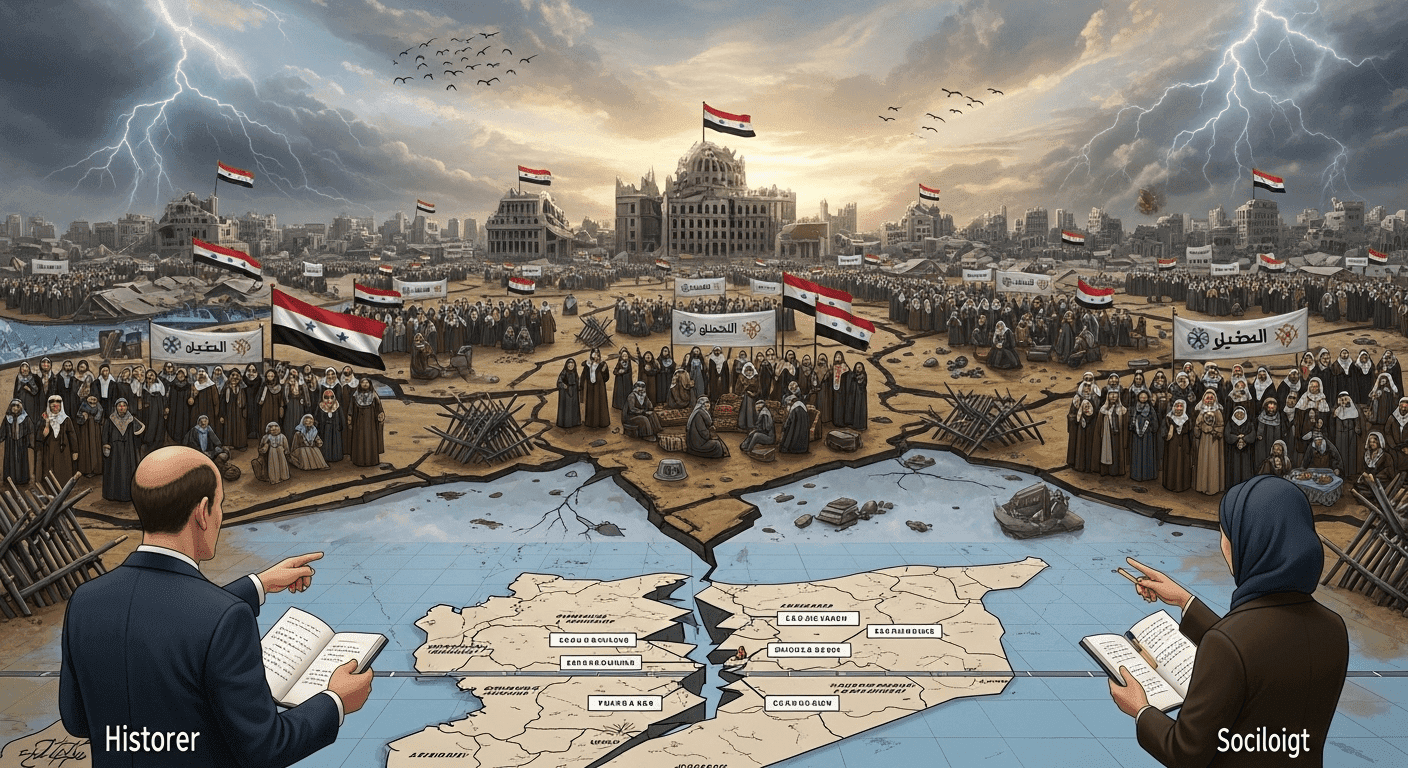
Introduction: The Fall of the Idol and the Fracturing of the Structure
On 8 December 2024, the world witnessed the dramatic end of an era spanning over half a century, with the collapse of the Assad family regime in Syria. This fall was not the result of a single, decisive battle; rather, it was the culmination of a rapid, cascading disintegration that began on 27 November. Rolling like a snowball from Idlib to Aleppo, then onward through Hama and Homs, it finally reached the heart of the capital, Damascus. The astonishing speed of this collapse reveals not only the military prowess and meticulous planning of the opposition factions but points more deeply to the structural fragility and internal decay that had hollowed out the Syrian state under decades of autocracy and 13 years of devastating civil war.
This report presents a central hypothesis: the collapse of the highly centralised, authoritarian state in Syria does not merely create a power vacuum. Instead, it resurrects suppressed social structures and primary identities, tribal, sectarian, and regional, that were kept dormant under an iron security grip but never truly disappeared. This situation presents a striking and troubling parallel to the socio-political dynamics of the pre-Islamic Arabian Peninsula, where Asabiyyah (group solidarity or tribal cohesion) was the primary driver of alliance and conflict in the absence of a unifying central authority. Understanding the challenges facing Syria today requires us to look beyond immediate political analysis and delve into deeper historical and sociological strata.
To explore this, the report follows a structured, analytical pathway:
- Chapter 1 establishes the theoretical and historical framework, drawing inspiration from the tribal structures of the Jahiliyyah (pre-Islamic era), Ibn Khaldun's theory of Asabiyyah, and the model of the "Constitution of Medina" as a historic social contract.
- Chapter 2 uses this framework as an analytical lens to understand the dynamics of the Syrian state's collapse in December 2024.
- Chapter 3 diagnoses the monumental security, political, economic, and social challenges of the transitional phase.
- Chapter 4 applies the concept of Asabiyyah directly to analyse the resurgence of sub-national identities and their rise as primary actors in the new Syrian landscape.
- Chapter 5 looks ahead to pathways for building a new social contract and a unifying national identity, drawing on historical and practical lessons to outline how Syria can avoid sliding into a state of perpetual chaos.
Chapter 1: Theoretical and Historical Framework: From Tribe to State
To comprehend the depth of the current Syrian crisis, we must look to historical and sociological models that explain how societies behave when central authority vanishes. The history of the pre-Islamic Arabian Peninsula, combined with the profound insights of Ibn Khaldun, provides a rich theoretical framework to dissect today's fragmentation and the rise of primordial identities.
Pre-State Society: Tribal Structure and the Absence of Central Authority in the Jahiliyyah
In the pre-Islamic era, the social and political structure of most of the Arabian Peninsula revolved around the "tribe" as the fundamental unit organising individual and collective life. The tribe was not merely a demographic grouping; it was an integrated entity providing its members with identity, security, and socio-economic protection. It was composed of a core nucleus, the Salibah (those bound by direct bloodlines and lineage), surrounded by Mulhaqun (allies from smaller tribes or individuals who sought their protection). At the head of this structure stood the tribal chieftain, whose authority was not absolute but rested on his personal prestige, wisdom, courage, generosity, and the consensus of the tribal elders.
The most prominent feature of this political system was the total absence of a unifying central authority. This lack of a modern state framework, an institution holding a monopoly on the legitimate use of violence and enforcing a uniform law over a defined territory, resulted in extreme political fluidity and near-perpetual conflict.
This condition manifested in Ayyam al-Arab ("The Days of the Arabs"), a term historians used to describe the endless battles and skirmishes between tribes. Chroniclers have recorded over 1,700 of these "days," indicating that warfare was the natural state of affairs, and peace was merely the exception. The triggers for these wars were diverse and complex: some stemmed from competition over scarce resources, such as disputes over water wells and pastures; others were fought over tribal honour, protecting neighbours, or seeking blood-revenge. Remarkably, devastating wars lasted for decades over trivial incidents: the Basus War between Bakr and Taghlib was ignited by the killing of a camel, whilst the Dahis and al-Ghabra war between Abs and Dhubyan began as a dispute over a horse race.
The link between the absence of a central state and the dominance of tribal loyalty was not accidental; it was a direct causal relationship. Without an institution capable of enforcing the law and providing security, tribal solidarity becomes the only available mechanism for survival.
Khaldunian Asabiyyah: The Engine of History and the Logic of Power
In his famous Muqaddimah, the scholar Abd al-Rahman ibn Khaldun presented a comprehensive theory to explain the rise and fall of empires, centring on the concept of Asabiyyah (group solidarity, social cohesion, or collective consciousness). Ibn Khaldun defined Asabiyyah as the collective consciousness or spirit of solidarity that binds a group together, compelling them to support and defend one another. This solidarity originates in its purest and strongest form from blood ties and lineage, but it can expand to encompass alliances, client-patron relationships, or long-standing companionship.
Ibn Khaldun argued that Asabiyyah is the primary engine of political history. It is the force that enables groups to defend themselves, defeat others, and demand political authority: "the goal of Asabiyyah is royal authority (al-Mulk)." Achieving al-Mulk, founding a state, inevitably requires struggle and dominance, which can only be achieved by a cohesive group possessing a strong Asabiyyah.
However, Ibn Khaldun offered a critical insight regarding the Arabs in particular. He observed that because of their natural pride, ambition, and fierce competition for leadership, royal authority is rarely established among the Arabs unless it is infused with a "religious colouring" (Sibghah Diniyyah). Religion alone is capable of removing the mutual jealousy and competition inherent in clashing tribal solidarity, uniting their focus toward a higher goal.
This theory is completed by the concept of the "dynastic cycle." A state, like a living organism, has a natural lifespan. Its cycle begins with a strong Asabiyyah, often nomadic, characterised by toughness and courage, which manages to overthrow an existing dynasty and build its state on the ruins. Over time, this ruling group transitions from nomadism to civilisation, and from hardship to luxury, which inevitably erodes their Asabiyyah. As people lose their martial spirit, the state grows old and incapable of defending itself, eventually becoming easy prey for a fresh, vigorous Asabiyyah emerging from the peripheries, and the cycle begins anew.
The "Constitution of Medina": A Historical Template for a Pluralistic Social Contract
In the midst of the society of Yathrib (Medina), which was fractured by deep divisions and devastating tribal wars, Islam, upon the Prophet Muhammad's migration, offered a unique model to transcend this fragmented reality. This model was represented by the "Constitution of Medina" (Sahifat al-Madinah), which many scholars consider the first written constitution in history to establish the concept of civic citizenship.
The most revolutionary principle of the Constitution was its declaration that the Muslims of Quraysh (the Emigrants) and Yathrib (the Helpers), along with those who followed and joined them, formed "one single nation (Ummah) to the exclusion of all other people." This was a profound shift: it transferred the foundation of belonging from bloodlines and tribal kinship to a shared creed and social contract.
Yet, this Ummah was not exclusive to Muslims. The Constitution established the principle of pluralistic citizenship, stating clearly that "the Jews of Bani Awf are one nation with the believers; the Jews have their religion and the Muslims have theirs." This recognition granted Jews and other allied tribes full civic rights in exchange for specific mutual duties.
To end the chaos and the "law of the jungle," the Constitution established two decisive pillars: collective security and a supreme reference point for dispute resolution. Security shifted from a tribal responsibility to a collective duty borne by all signatories. For dispute resolution, the Constitution declared that any controversy among the people of the document shall be "referred to God and to Muhammad, the Messenger of God," transferring judicial authority from tribal chiefs and the logic of blood-revenge to a central supreme authority.
Chapter 2: The Great Collapse: The Disintegration of the Syrian State (December 2024)
After more than half a century of rule with an iron fist, the Assad family regime in Syria collapsed in a dramatic and rapid fashion, leaving behind an immense vacuum and a highly complex political and security landscape.
Ten Days That Shook Syria: Chronology of the Fall
The actual end of the Assad regime began on 27 November 2024, when Hay'at Tahrir al-Sham (HTS) and other opposition factions launched a wide-scale military campaign named "Deterring Aggression." What initially appeared to be another round of the conflict quickly transformed into a lightning offensive that exposed the deep rot within the regime's structure. Within a few days, major cities fell like dominoes: Aleppo, Syria's largest city, fell with astonishing ease, followed quickly by Hama and then Homs, the regime's traditional strongholds.
The collapse of the Syrian Armed Forces was the decisive factor in this rapid fall. It was not merely a military defeat, but a comprehensive dissolution. Analyses indicate that this collapse was the product of factors accumulating over years: severe erosion of morale, depletion of personnel and equipment, and rampant corruption within its leadership. Most importantly, the regime's primary allies, specifically Russia, appeared to abandon any effective support in the final moments. Russian Foreign Minister Sergey Lavrov had admitted in 2017 that without Russian intervention, the regime would have fallen within weeks; in December 2024, that life support was pulled.
The collapse reached its climax on 7 and 8 December. As opposition forces approached Damascus from multiple axes and regime forces withdrew from the capital's suburbs, panic and chaos set in. On the morning of 8 December, reports confirmed that Bashar al-Assad had fled the country, later receiving asylum in Moscow. As opposition factions entered the heart of Damascus without encountering resistance, the end of the Assad family dynasty, which began with Hafez al-Assad's coup in 1971, was officially declared.
The Power Vacuum: The Immediate Aftermath of the Fall
With the fall of the head of the regime, Syria entered a perilous power vacuum. Opposition leaders, foremost among them Ahmad al-Sharaa (formerly known as Abu Mohammad al-Julani), showed a clear awareness of the need to avoid the total chaos that followed the collapse of other regimes in the region, particularly the Iraqi experience after 2003. This awareness was reflected in an initial discourse that focused heavily on "protecting state institutions from collapse."
The first step was tasking the Prime Minister of the previous regime's government, Mohammad Ghazi al-Jalali, with forming a temporary caretaker government to oversee state institutions until they could be formally handed over. This was a dual reassuring message: internally, that basic services would not cease; and externally, that the new powers were not a chaotic movement seeking to demolish the state.
Whilst this intelligent, short-term strategy aimed to grasp the "form" of the state after the disintegration of its oppressive "substance," it created a dangerous paradox for the long term. The pressing question is: can a new, pluralistic, and just state be built on the ruins and with the tools of the old state against which the people rebelled? These very institutions, the army, the security services, the judiciary, the bureaucracy, were for decades the primary instruments of oppression and corruption. This inherent tension between preserving the system to prevent anarchy and dismantling it to achieve justice will form the primary source of political and social instability during the transitional phase.
The most aggressive and decisive reaction came from Israel, which capitalised on the power vacuum to launch what was described as "the largest air campaign in its history" to systematically destroy the Syrian military infrastructure and missile arsenal, and extend its control over the buffer zone in the Golan Heights.
Chapter 3: Challenges of "The Day After": Syria at a Crossroads
As the dust of battle settled and the regime fell, Syria confronted a complex new reality and a monumental set of challenges that threatened to turn the joy of liberation into a nightmare of chaos and division.
The Security Challenge: He Who Holds the Weapon Holds the Power?
The most immediate and critical challenge was security. With the collapse of the regular army, control did not devolve to a single, unified military force, but to a complex mosaic of armed factions with differing ideologies, interests, and external backers. Syria's military map dissolved into an archipelago of spheres of influence.
| Faction / Entity | Ideological Alignment | Primary Spheres | Key External Backer |
|---|---|---|---|
| Transitional Government Forces (former HTS core) | Sunni Islamist, pragmatic | Damascus, Aleppo, Hama, Homs, Idlib | Qatar, Turkey (indirectly) |
| Syrian National Army (SNA) | Islamist, nationalist, fragmented | Northern Aleppo | Turkey |
| Syrian Democratic Forces (SDF) | Left-leaning, Kurdish, secularist | Northeast Syria (Hasakah, Deir ez-Zor) | United States |
| Free Syrian Army (formerly Mughawir al-Thawra) | Nationalist, secular | Al-Tanf region | United States, Jordan |
| Southern Factions (formerly 8th Brigade) | Localist, reconciled | Daraa, Sweida | Russia (formerly), Jordan |
| Syrian Army Remnants / Loyalists | Loyal to the former regime | Coastal pockets, rural Homs | Iran, Russia (diminishing) |
Faced with this fragmented reality, building a new national army is a monumental task. It requires either integrating these disparate factions into a single military structure under a unifying national doctrine, or attempting to disarm them by force, which could ignite a new civil war among the former opposition forces.
This landscape is further complicated by the continued presence of foreign military bases. The Russian bases in Hmeimim and Tartus, the Turkish presence in the north, and the US bases in the east and Tanf do not merely represent a violation of sovereignty; they act as guarantors of the various spheres of influence, preventing any single domestic actor from resolving the conflict militarily.
The Political and Governance Challenge: Searching for a Lost Legitimacy
Politically, the immediate challenge was filling the power vacuum and forming a government capable of running the country. This occurred in two stages: first, a temporary caretaker government headed by Mohammad al-Bashir, head of the "Salvation Government" in Idlib. Second, in March 2025, an expanded transitional government was formed in which the post of prime minister was abolished, and transitional president Ahmad al-Sharaa began directly supervising the cabinet.
Despite attempts to present this cabinet as a "technocratic" government comprising experts from diverse backgrounds, including representatives of certain minorities (Druze, Kurdish, Alawite, and a female Christian minister), it faced widespread criticism. Many Syrian observers and activists view this lineup as a facade concealing the dominance of former HTS figures over sovereign and sensitive positions. This perception undermined the government's legitimacy from day one.
The greatest challenge to the state's legitimacy and territorial integrity emerged from the northeast, where the Kurdish "Autonomous Administration" declared its refusal to deal with the new government, arguing that it perpetuates an exclusionary, centralised approach and fails to recognise the rights of other components. This stance represents the deepest political rift in post-Assad Syria, threatening to divide the country into distinct political and administrative fiefdoms.
On the international front, the United States and the European Union conditioned formal recognition of the new government and the lifting of economic sanctions on strict criteria: full respect for minority rights, preventing Syria from being used as a base for terrorism, and securing and destroying any remaining chemical weapons stockpiles. Sanctions were partially lifted in May 2025 following commitments made by Damascus, but the new government remains under close observation.
The Economic and Social Challenge: Rebuilding a Devastated Homeland
The new authority inherited a ruined country, a collapsed economy, and a fractured society. Over 90% of the population lives below the poverty line, and approximately 16.7 million Syrians require some form of humanitarian aid. The scale of destruction in infrastructure and housing is immense.
The task of reconstruction seems nearly impossible under current conditions. The challenge is not restricted to securing massive international funding; it extends to highly complex legal and social issues, chief among these the file of property, land, and housing rights, where years of displacement, forced eviction, and demographic change have created property disputes that are incredibly difficult to untangle.
On the social level, perhaps the greatest danger is the rise of hate speech and retributive violence. Human rights reports indicate an escalation of sectarian-tinged violence in friction zones between different communities. This rhetoric, fuelled by past grievances and the absence of justice mechanisms, threatens to disintegrate what remains of the fragile social fabric.
Chapter 4: The New "Asabiyyahs": A Sociological Analysis of Syrian Reality
Applying Ibn Khaldun's theoretical framework to contemporary Syrian reality reveals deeply troubling structural parallels. With the collapse of the Mulk (royal authority) represented by the autocratic Ba'athist state, Asabiyyah has returned as the primary driver of social and political action. Loyalty to the state or a unifying Syrian national identity has receded, replaced by smaller, more primordial allegiances.
The Return of Primary Identities: Sect, Clan, and Region as Contemporary Asabiyyahs
What we are witnessing in Syria today is a living application of Khaldunian theory. The collapse of the coercive central state has unleashed long-suppressed sub-national identities. Sect, ethnicity, clan, and geography have transformed into contemporary Asabiyyahs around which human groups cluster in search of security and belonging.
This phenomenon is clear across the country. In the Alawite-majority coastal regions and in the Druze-majority province of Sweida, a deep sense of anxiety prevails regarding the new authority, which is perceived as representing a rival Asabiyyah. This fear drives these communities to rally around their traditional and religious leaderships and form local militias to defend their regions.
In northeast Syria, the SDF and the Autonomous Administration represent the clearest embodiment of a Kurdish ethno-political Asabiyyah seeking to protect its gains in self-governance.
Even within the Sunni Arab community itself, regional and tribal divisions are highly active. Factions in the Turkish-backed north compete with factions in the interior, and tribal loyalties in the eastern region emerge as a powerful force that cannot be sidelined. Every group views the other with suspicion, believing that its security can only be guaranteed by the strength of its own Asabiyyah, the exact logic that governed the pre-Islamic Ayyam al-Arab.
The Absence of Justice and the Fuelling of Retribution: Will the Cycle of Ayyam al-Arab Repeat?
The greatest danger in this reality is that it threatens to lock Syria into an endless cycle of retributive violence, closely resembling the blood-feuds of the pre-Islamic era. The absence of credible transitional justice mechanisms in Syria today opens the door wide to individual and collective retribution.
The Syrian Network for Human Rights (SNHR) has warned that delays in establishing institutional justice directly fuel retributive impulses, undermining any opportunity for national reconciliation. When victims and their families lose hope that the state will deliver justice, they inevitably take the law into their own hands.
The concrete risks facing Syria in this context include:
- Destruction of Evidence: Over time, individuals complicit in war crimes attempt to destroy documents and evidence, making future prosecutions much more difficult.
- Flight of Perpetrators: Many senior figures responsible for human rights abuses succeed in fleeing the country, securing impunity and deepening the victims' sense of injustice.
- Escalation of Individual Revenge: In the absence of institutional channels, personal retribution becomes the only available path for many, leading to targeted killings and kidnappings that spark micro-civil wars between families, clans, and sects.
- Entrenching Divisions: The lack of a comprehensive path for truth-seeking, accountability, and reconciliation transforms political differences into rigid sectarian and ethnic identities that become impossible to bridge in the future.
Transitional justice in Syria is therefore not merely a legal pathway to punish criminals, or a luxury that can be postponed. It is a critical tool for rebuilding the state and forging a "national Asabiyyah." By applying impartial and comprehensive justice that addresses the grievances of all Syrian components, the new authority can transcend its narrow origins and begin building bridges of trust. This is the only path to creating the foundation for a new national solidarity, built not on blood or sect, but on citizenship, justice, and the rule of law.
Chapter 5: Towards a New Social Contract: Lessons from History and Geography
Syria stands at a historic crossroads. It will either slide into fragmentation and permanent conflict driven by competing Asabiyyahs, or it will succeed in crafting a new social contract that establishes a unifying state of citizenship.
The Dilemmas of National Identity: Conflicting Reference Points and Visions
The core of the conflict in post-Assad Syria is no longer just a struggle for power; it is a deeper conflict over the identity of the state and the nature of the social contract that will govern it. Primary disputes revolve around three fateful questions:
The Identity of the State and the Source of Legislation: Will Syria be a state with an Islamic identity, where Islamic jurisprudence (Fiqh) is the primary source of legislation, as demanded by a large segment of the Islamist currents forming the core of the new authority? Or will it be a modern, secular state, neutral toward religion, separating religious and political institutions, as advocated by secular and liberal elites and parts of the minority communities?
The Structure of Governance (Central vs. Decentralised): Should Syria maintain its structure as a strong centralised state, as indicated by the transitional government's attempts to project its control from Damascus over the entire country? Or does the solution lie in adopting a decentralised or federal system that grants different components, especially the Kurds in the northeast, a high degree of autonomy? The Kurds view centralisation as a continuation of exclusion, whilst the central authority fears that federalism will lead to partition.
The Concept of Citizenship and a Unifying Identity: How can a new Syrian national identity be built that unites all its components? Progressive intellectual and political initiatives suggest that modern national identity must rest on equal citizenship, the recognition of cultural, linguistic, and religious diversity as a source of strength, and a focus on rights, freedoms, and justice for all.
| Dimension | Conservative Islamist Vision | Secular / Civic Vision | Federal / Decentralised Vision |
|---|---|---|---|
| State Identity | Islamic, with protected status for other religions | Civic, neutral toward religion | Democratic, pluralistic, decentralised |
| Source of Legislation | Islamic jurisprudence as the primary source | Positive law, separation of religion and state | Democratic constitution guaranteeing component rights |
| Minority Rights | Protected rights within the framework of Sharia | Full equality in citizenship | Self-governance, cultural, and linguistic rights |
| Structure of Governance | Republican, centralised | Republican, centralised or administratively decentralised | Decentralised / Federal |
| Primary Proponents | Islamist currents, Transitional Government leadership | Secular elites, civic activists, liberal opposition | Autonomous Administration, Kurdish parties |
Transitional Justice Pathways: Accountability, Reconciliation, and Redress
No new social contract can be built on a foundation of unaddressed grievances and blood. Transitional justice is an indispensable prerequisite for achieving national reconciliation. This process faces immense hurdles, chief among them the International Criminal Court's lack of jurisdiction over crimes committed in Syria (unless the new government decides to accede to the Rome Statute), and the difficulty of prosecuting and extraditing perpetrators who have fled abroad.
Despite these obstacles, several models and mechanisms can be adapted to Syria's reality:
| Mechanism | Description and Objectives | International Examples | Implementation Challenges in Syria |
|---|---|---|---|
| International Criminal Accountability | Prosecuting top-tier officials before the ICC | Former Yugoslavia, Rwanda | Requires Syria's accession to the ICC or a UN Security Council referral (highly difficult) |
| Specialised Domestic Courts | Establishing special Syrian tribunals for war crimes and crimes against humanity | Argentina, Chile | Requires a radical reform of the judiciary; risks accusations of "victor's justice" |
| Truth and Reconciliation Commissions | Non-judicial bodies to gather testimonies, document violations, and uncover the truth | South Africa, Argentina | Requires high levels of trust among all parties; may be perceived as a substitute for prosecution |
| Institutional Reform (Lustration) | Vetting public servants and removing compromised individuals | Poland, East Germany | Risk of turning into political revenge; difficult to balance with the state's need for expertise |
| Reparations Programmes | Material and symbolic compensation, rehabilitation, and national memorialisation | Global | Exorbitant economic cost in the context of a devastated state and collapsed economy |
Recommendations for Building a Stable State: Inspiring the "Constitution of Medina"
The historical model of the "Constitution of Medina" offers, despite the immense difference in time and context, fundamental principles that can be inspired to draft a new Syrian social contract. Based on this logic, the following recommendations are presented:
Building a "Nation" (Ummah) Rather than a "Sectarian State": The highest priority is to launch an inclusive national dialogue in which all political forces and socio-cultural and religious components participate without exclusion, with the aim of drafting a new constitution. This constitution must form the foundation of a unifying Syrian national identity that recognises pluralism as a source of strength.
Monopolising the Legitimate Use of Violence: No genuine state can exist in the presence of multiple armies and militias. The strategic priority of the transitional authority must be to integrate armed factions into a single national army subject to an elected civilian authority, with a clear national doctrine focused on protecting the state's borders and its constitution.
Establishing a Supreme Reference for Justice: Independent and credible judicial bodies must be established rapidly, and transitional justice pathways activated. The presence of an impartial judicial reference is the only way to block the logic of vendetta and revenge, building the citizen's trust in the state as the ultimate guarantor of justice.
A Collective Defence Pact: In the face of external interventions that undermine Syrian sovereignty, the new social contract must include the principle of collective defence. This requires a unified national strategy to deal with the foreign military presence, gradually reclaiming sovereignty through diplomatic and political channels.
Conclusion: The Future of Syria Between Historical Inevitability and the Will of the People
A deep analysis of the rapid collapse of the Syrian state in December 2024 reveals a phenomenon that goes beyond a mere change of political regime. What occurred was the disintegration of a highly centralised power that had imposed a form of coercive unity. In the vacuum left by this disintegration, ancient social and political dynamics have re-emerged with force, the dynamics of Asabiyyah described by Ibn Khaldun, which prevailed in pre-state societies like pre-Islamic Arabia.
The ultimate challenge facing Syria today is how to transition from the logic of a "victorious Asabiyyah," where each faction seeks to impose its dominance, to the logic of a "unifying social contract" that establishes a state of citizenship and justice. The historical approaches reviewed in this report, whether the negative template of Ayyam al-Arab or the positive template of the Constitution of Medina, are not inevitable destinies bound to repeat themselves; they are tools for understanding, warning, and learning.
Today, Syrians stand before a historic opportunity, albeit one fraught with immense risks and challenges, to transcend the legacy of tyranny and fragmentation they have long endured. Their success in building a stable, modern state depends ultimately on their capacity to learn from the lessons of their distant and recent history, and on their choice between the path of conflict and dominance, which leads only to further ruin, and the path of consensus, partnership, and justice, which alone can build a better future.
Further reading
- The 'Umayyad Comeback' in Post-Assad Syria
Both read post-Assad legitimacy through misused Islamic history; the Umayyad-comeback narrative is the sectarian counterpart to the Constitution-of-Medina inclusive model this piece proposes.
- From Militia Mindset to Mature Governance in Syria
Both diagnose the transitional government's failure to build inclusive statehood; militia-mindset governance is the practical face of a single victorious Asabiyyah refusing a social contract.
- Acute polarisation in Syria
The resurrected sectarian and regional identities described here are the raw material of the loyalist-versus-traitor polarisation that piece dissects.
- Syria's Reconstruction: Navigating the Labyrinth of Destruction, Law, and Geopolitics
Shared focus on the fragmented post-Assad security map and how an exclusionary settlement entrenches conflict rather than resolving it.
Related posts
Syria After the Wildfires: Constructive Steps for Government Responsibility
Thankfully, the immediate threat of the recent wildfires has subsided. Now, as the smoke clears, the true challenges facing our nation are laid bare. The government's responsibilities must shift from immediate crisis management to the complex, long-term task of recovery and building resilience.
Ensuring Social Services in Syrian Public Sector Reform Post-Assad
The Assad state carried “ghost employees” for decades, and dismantling that payroll is a genuine and urgent reform. It is also a decision about who eats next month, taken by a government with little fiscal room and no reliable count of the people it is about to release. This argues for sequencing the social safety net ahead of the layoffs, and treats the missing data as the central problem rather than a footnote.
Syria's Vision for the Future vs. a Shadowy Reality
Syria’s Crossroads: A Vision for the Future vs. a Shadowy Reality A recent Reuters report, Syria is secretly reshaping its economy. The president’s brother is in charge, raises serious concerns about the country’s economic future after the conflict. The report claims a secret “shadow committee,” led by President Ahmed al-Sharaa’s older brother, Hazem al-Sharaa, is managing