Before the Register Is Digitised: What Syria's Property Conference Did Not Say
On 15 September 2026 the Ministry of Local Administration held a conference on real estate management and property rights and proposed four things: digitise the land registers, simplify procedures, steer development by property data, and find financing. None of the four decides whose name belongs in the register. That is settled by at least nine statutes, most written by the government this one replaced and every one still in force, and the conference named none of them. This piece sets the instruments out with their windows and remedies, reads the register's own coverage figures, follows one family through Law 33's six months, and puts five other states' claims mechanisms beside Syria's, on each body's own numbers.
15 September 2026. A standalone article drawing on the forthcoming book The Numbers That Do Not Hold. Every figure carries its publisher, unit and date; every calculation that is mine says so.
On Tuesday 15 September 2026 the Ministry of Local Administration and Environment held a conference at the Sham Hotel in Damascus under the title "Real Estate Management and Property Rights". The state news agency's report of it names three ministers, the head of the Planning and Statistics Authority and the Director-General of Real Estate, and gives the purpose as presenting "investment priorities and financing needs in the field of real estate management" so as to strengthen coordination "between government bodies, international partners and donors". The ministry's own posts the day before put the programme in four lines: digitise the land registers to protect rights, simplify procedures, direct development by precise property information, and build partnerships for sustainable financing. Its slogan is that secure property is the basis of stability and development.
I agree with the slogan. What follows is about the distance between it and the four lines, and the distance is a legal one. A register can be digitised, its procedures shortened and its data used to steer money, and none of that decides whose name should be in it. That question is answered by statutes, most of them written between 2011 and 2021 by the government this one replaced, every one of which stands unrepealed so far as I can establish, on the search set out below, and not one of which the conference report names.
What the conference said, and the one sentence that matters
The minister, Mohammed Anjarani, said that after fourteen years of war "the responsibility falls on us to establish the rights of the people and to remove the difficulties that stand in the way of their return to their homes", and that the aim is for a citizen to obtain "his property document with the least effort and in the shortest possible time". The communications minister, Abdulsalam Haykal, called the land register "a strategic project of exceptional importance". The head of the Planning and Statistics Authority, Anas Salim, spoke of the need for "a precise and organised property database" and offered his authority as a partner in "addressing previous violations". The Director-General of Real Estate, Abdulkarim Idris, said real estate administration must be "efficient, effective and transparent" and that recent work had concentrated on cooperation between public bodies and "international cooperation partners".
The justice minister, Mazhar al-Wais, said something different in kind, as the agency reports him. The former regime's policies, he said, had left "contradictions and legislative complications, especially in matters of ownership, construction and zoning", producing "unacceptable complications that push citizens to seek exits outside the legal frameworks", which burdens the courts, "particularly in cases concerning what are known as customary contracts". Then: "The right of property is a sacred right, affirmed by the revealed laws and guaranteed by the Constitutional Declaration ... no body or person may encroach on a citizen's right to what he owns, and if the public interest requires a measure that touches private property, it must be carried out according to the law and in a way that guarantees fair compensation."
That sentence is the standard everything below is measured against, and the minister set it himself.
What the report does not contain: the name of any law or decree; any count of records held, damaged or lost; any count of claims, properties or claimants; the name of any international organisation in the room; any mention of the several million people the property laws apply to who are outside the country, of the third of the urban population who lived in informal housing before the war, of people now living in homes that belong to somebody else, or of a procedure by which any of them would make a claim. It records no recommendation and no decision.
The statute book the conference sits on
The forthcoming book's fourth chapter set out the property instruments Syria inherited, and I will quote its summary of the problem rather than restate it: "for most of the land in question nobody can establish which instrument applies, that the answer determines how long a family has to come forward, what they receive if they do, and whether they receive anything at all if they do not, and that the state has repeatedly acted on the land without saying under what authority it was acting." The table below is the instruments as they stand, with the window each gives a claimant, the remedy it provides and the appeal it allows, taken from the text where I have read the text and from a named account where I have not.
| Instrument | What it does | Claimant's window | Remedy | Appeal | Status, 15 September 2026 |
|---|---|---|---|---|---|
| Legislative Decree 66 of 2012 | Two redevelopment zones in Damascus; enumeration and rehousing; produced Marota City | One calendar year from the announcement (Law 42 of 2018) | Shares in the zone; unclaimed shares sold at auction, proceeds paid to the owner every six months in proportion to their holding (Article 32, read at the text) | Court of Appeal, as amended by Law 10 | In force |
| Law 10 of 2018 (amended by Law 42 of 2018) | Decree 66 extended to the whole country by decree on the minister's proposal | One calendar year from the announcement (thirty days as passed; Law 42 of 2018); owner comes forward with documents "if any exist" (Article 6, read at the text) | Shares in the new plots (Article 27) | Civil Court of Appeal, thirty days, final | In force; not on the ministry's own laws page |
| Law 3 of 2018 | Rubble removal; governor determines damaged buildings | One month to prove rights (The Syria Report's account) | Right to one's own rubble; silent on the land | None against the governor's decision | In force; under review by a ministry committee since summer 2026, a draft amending instrument being prepared |
| Law 23 of 2015 | Urban planning; seizure during zoning | Per scheme | Per scheme | Per scheme | In force |
| Law 18 of 2021, amended by Decree 114 of 2025 | Development zones covering war-damaged areas; investors may own or lease (The Syria Report's account) | Not a claims instrument | Not a claims instrument | Not applicable | In force, amended by the transitional government |
| Law 31 of 2018 | Endowments; leasing, exchange and investment of waqf property | Not a claims instrument | Not applicable | Not applicable | In force; some 34,000 waqf properties being re-rated, on the deputy minister's figure as reported |
| Legislative Decree 11 of 2016 | Suspends registration in offices closed for security; "daily supplementary records" kept in government-held towns (PAX account) | Not applicable | Not applicable | Not applicable | In force so far as I can establish |
| Legislative Decree 12 of 2016 | Digital copies given the evidentiary force of the original, under conditions the minister sets (PAX account) | Four months to object at the court of first instance | Not applicable | Court of Appeal | In force so far as I can establish |
| Law 33 of 2017 | Reconstitution of lost or damaged registry documents, administrative or judicial (read at the text) | Six months from a notice in the Gazette and two newspapers | The rebuilt sheet | Fifteen days; then five years to sue, fifteen for compensation | In force and running |
| Legislative Decree 63 of 2012 | Precautionary attachment of assets in terrorism cases (PAX account; the recital of Decree 16 of 2025) | Not applicable | Not applicable | Not applicable | In force; attachment decisions of 2012 to 2024 cancelled by Decree 16 of 2025 |
| Legislative Decree 237 of 2021 | Zoning of Qaboun and Harasta, stating no law it acts under (Syrians for Truth and Justice's account) | Thirty days in the decree; whether Law 42's year reaches it the decree does not say | Not stated | Not stated | In force so far as I can establish |
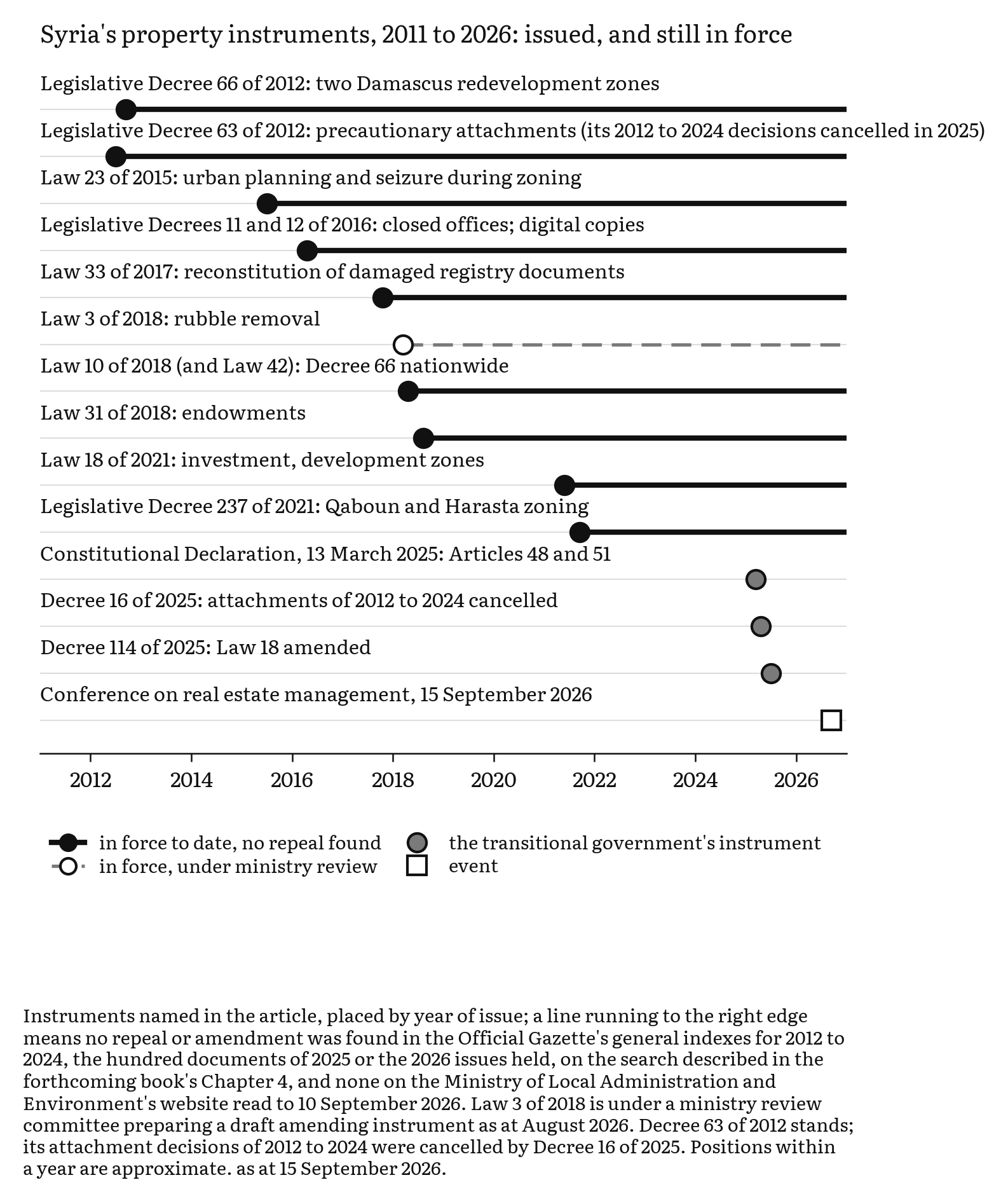
Two things about the table. First, the book's sentence on Law 10 still holds: "So Law 10 is not a new scheme. It is Decree 66 with its geographical limit removed." Second, the status column rests on a search whose scope the book states and I will not restate in full: no repeal of Decree 66, Law 10 or Law 3 appears in the Official Gazette's general indexes for 2012 to 2024, in the hundred documents of 2025 or in the 2026 issues held, and the Constitutional Declaration of 13 March 2025 does not repeal them either. Its Article 48 directs the state to cancel exceptional laws that harmed the Syrian people and cancels nothing by its own force; its Article 51 keeps legislation in force until amended or repealed. The one cancellation the transitional government has made in this field, on that search, is of the attachment decisions of 2012 to 2024 under Decree 63, by Decree 16 of 2025; Decree 63 itself stands. The ministry's own website, read whole through 10 September, lists seven laws on its laws page, and neither Law 10 nor Decree 66 is among them; the same site records that Law 3 of 2018 was put to a review committee this summer and that the committee was preparing a draft amending instrument in August. Beside that there is Decree 114 of 2025 amending the investment law, and a draft amendment of the endowments law the minister said in August was ready for the Assembly. That is the visible movement on the inherited statutes in twenty-one months, and none of it touches the three instruments that set a claimant's window.
What "digitise the records" means when the records are these
The conference's first pillar is to speed up "automation of the real estate registers to protect them and to guarantee the reliability of their data completely". Three facts about the registers, all from the state's own side, bear on what that guarantee can mean.
The first is what the register covers. In February 2026 the Director-General told the state agency that "about 95 per cent of the land eligible for ownership in the Syrian Arab Republic is registered in the land register, and constitutes about 60 per cent of the area of Syria". The 2013 briefing note of the humanitarian Protection Cluster put state land at 62 per cent of the country and private land at 38, and said "an estimated 20% of state land is registered", that "land registries exist in all 14 Governorates, but there is no overall national register and the register only covers 'formally' transacted land and property", and that temporary and permanent registers run in parallel. The two are not in conflict, because they are not the same measure: one is a share of ownable land, the other of state land. Together they say the register is nearly complete for the land it was built to cover and covers a fifth of the rest. The Norwegian Refugee Council's 2016 briefing adds the temporal limit: "the process of digitalising these records that started in 2010 was only used for new records, so did not include transactions that occurred before 2010."
The second is who lived on the land the register does not cover. The 2013 note: "Some 32% of the total urban population is estimated to live in informal settlements." NRC in 2016: about a third of the urban population, and "in Damascus and Homs, for instance, between forty and fifty percent". In Aleppo, on a UN-Habitat profile of May 2014 that NRC cites, "the majority of heavy damage was to informal settlements". In Aleppo at least, the register's silence and the war's damage fell on the same people. The justice minister's "customary contracts" are, on the account a member of the Bar Association's central council gave the state agency in February, the paper such people hold.
The third is what happened to the registers that did exist. NRC in 2016 reported them "damaged and/or destroyed as a result of the crisis". The Director-General in February 2026 said "a number of the real estate offices have stopped working or face difficulties in completing delimitation and partition work". The only counts in the documents opened for this article are the ministry's own, from January 2026, for the three cadastral areas where reconstitution committees began work in December 2025: in Zamalka in Rif Dimashq, twelve base registers and 203 annexes damaged or lost and 15,489 property sheets damaged; in al-Bughayliyah in Deir ez-Zor, 6,550 sheets damaged and 62 partly; in Taldou in Homs, 2,551. That is 24,652 damaged sheets in three areas, my addition. By 6 January the committees had checked over 5,400 sheets in Zamalka and al-Bughayliyah together and, in Taldou, "more than 1,500" properties, which is a different unit and is not added to the first. No national count appears in either of the agency's reports or on the ministry's website as read to 10 September 2026, and I have not searched the humanitarian reporting for one; the three areas are where the committees started, not a sample.
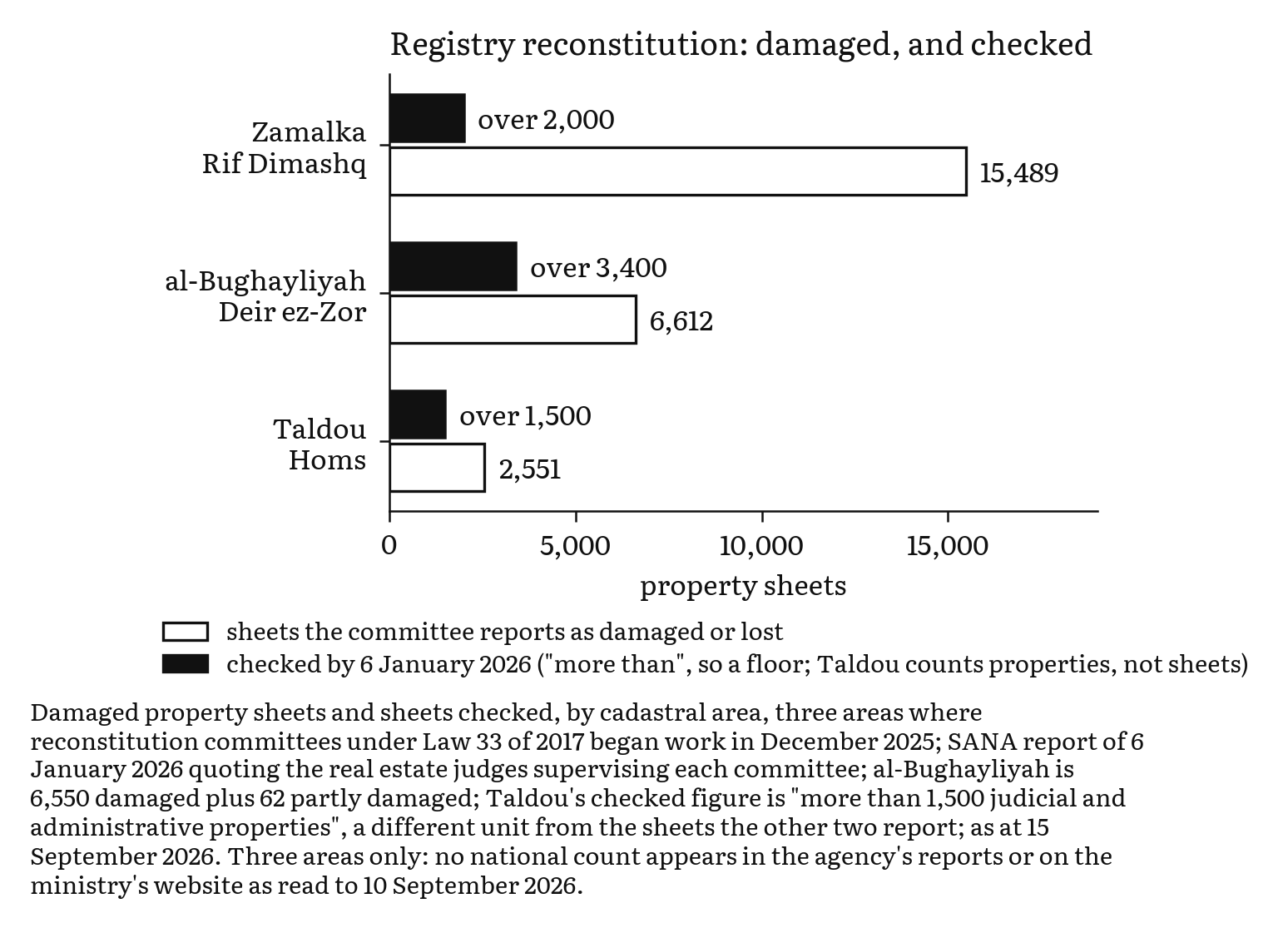
The law those committees work under is the one property statute the ministry itself reports applying this month, and the conference did not name it either.
Law 33 of 2017 governs the reconstitution of lost or damaged registry documents. I have read it on the ministry's own website. Where the directorate holds enough documents, it rebuilds the sheet administratively, publishes the decision in the Official Gazette, treats that publication as personal notice, and allows fifteen days to appeal. Where it does not, a real estate judge publishes a preparatory decision "in the Official Gazette and in two local newspapers" and gives interested parties "six months from the date of publication" to submit documents supporting the rights recorded on the damaged sheet. An objection that comes without documents requires the objector or their lawyer to attend in person, on pain of being struck out. Sheets nobody objects to are confirmed by a decision that is final. After confirmation a person has five years to sue for the right itself and fifteen for compensation, and after five years the reconstituted sheet acquires "absolute probative force".
Take a worked example: a family from Zamalka now in Gaziantep or Berlin has six months from a notice in a Damascus newspaper to produce papers many left in a house that no longer stands, or to appear in person before a judge in Rif Dimashq. The statute does not say how they are to learn of the notice. It is the structure of Article 6 of Law 10, a window, a burden on the claimant, and a consequence for silence that the claimant is left to discover, written more carefully, with an administrative path and a five-year door, and applied to registers damaged in three areas. Nobody at the conference said which windows are open now and where.
The book puts the technological point in one sentence I will not improve on: "A registry rebuilt on an immutable ledger records what it is given, and where the underlying entries are contested or forged, it makes them harder to correct rather than easier." Decree 12 of 2016, on the account I have, already gives a digital copy the evidentiary force of the original under conditions the minister sets. A digitisation programme that starts from the 2010 to 2024 entries inherits every transaction of those years, including those made under Decree 11's supplementary records, which the PAX account says were set up for Arbin, Douma and Safira among others. Digitising them makes them faster to find. It does not make them true. The order is adjudicate, then digitise, and the conference proposed the second.
Who is not in the room
Four people the four pillars do not reach.
The claimant abroad. Law 10's Article 6 lets a relative to the fourth degree, or a holder of a legal power of attorney, claim on an absent owner's behalf; Law 33 gives six months from a newspaper. Neither says how an owner in Jordan learns that a window has opened, and nothing on the ministry's website as read to 10 September 2026, or in the two agency reports, describes a channel for it. The book's proposal here is a small one: "Say what happens to a person who is outside the country, and to a person living in a building somebody else owns."
The informal owner. A third of urban Syrians before the war, on the 2013 and 2016 notes; the majority of Aleppo's heavy damage. Their proof, on the same lawyer's account, is a sale contract, a court judgment obtained afterwards, a neighbour's or a mukhtar's word. Law 3 lets the governor clear the rubble and says nothing about the land; the book calls that "a third window and a third remedy, neither of them the same as the two above, and a silence where the substantive question is". The Planning Authority's offer to help "address previous violations" is, read from the informal owner's side, an offer to address them.
The occupant. People are living in homes that are not theirs; nobody has published a count, and the reasons run from resettlement to the owner's absence to seizure. No Syrian instrument I have read, and none in the accounts I have opened, provides for that person: no notice, no hearing, no alternative, no rule for what happens when the owner's claim succeeds. The book searched for such a provision to 16 August and found none, and says so as a statement about what it reached. Iraq, below, wrote one two years into its process and had to reopen its own decisions to do it.
The waqf tenant. Some thirty-four thousand endowment properties are being re-rated by the Ministry of Endowments, on a figure its deputy minister gave The Syria Report in November 2025, and the same ministry has asked the Turkish Presidency of Religious Affairs for the Ottoman waqf registers, for a purpose that has more than one account. The book's test applies: "If the Syrian registry is good enough to establish that a shopkeeper does not own his shop, it is good enough to establish that he does. If it is not good enough for the second, it cannot be good enough for the first."
What other states did after this kind of displacement
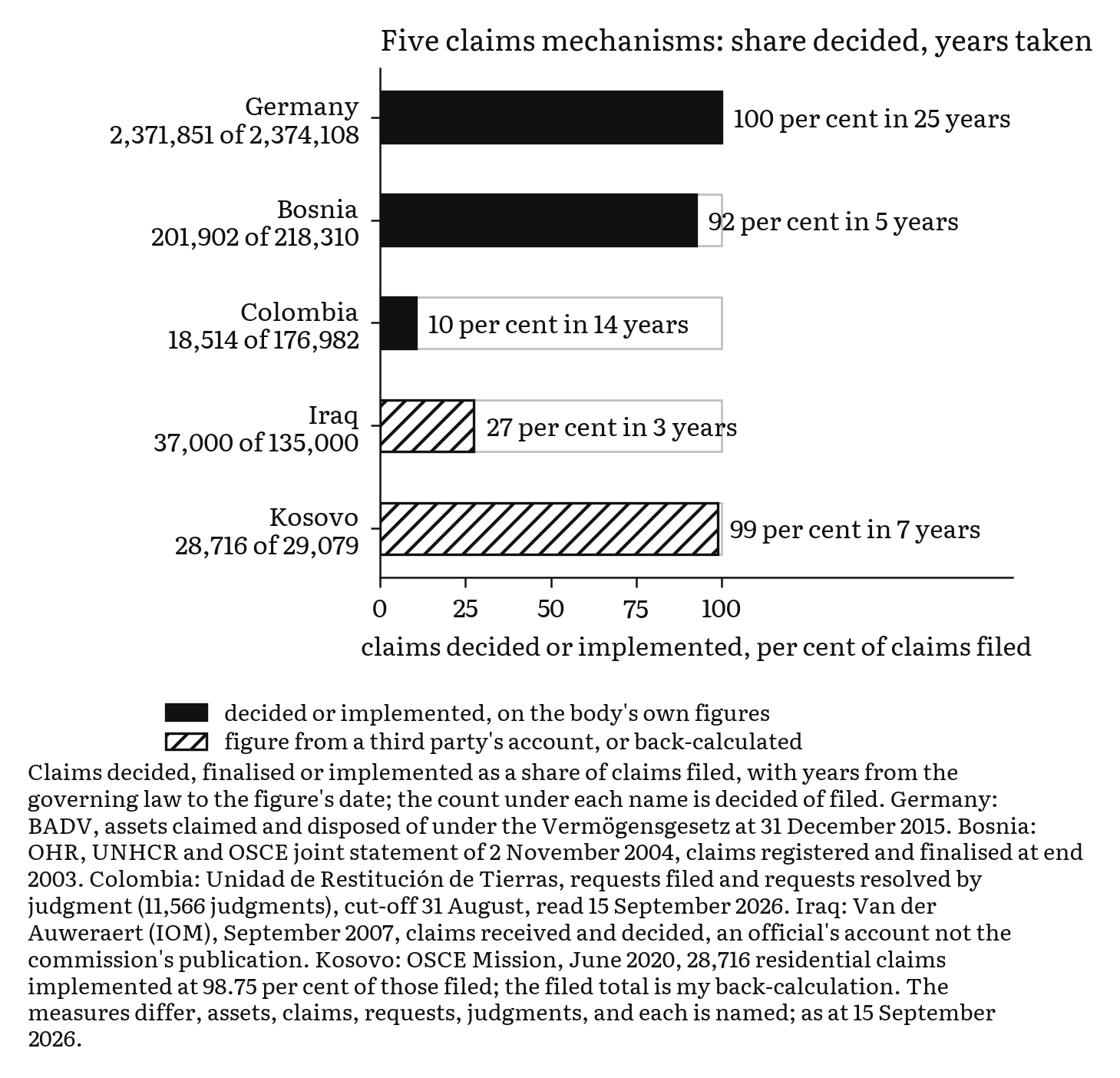
Syria's judiciary has started looking. In December 2025 a delegation of judges visited the land registry at Berlin's central court under a German cooperation programme on housing, land and property rights, and its head, Judge Abdulrazzaq al-Hussein, said the property challenges that came with Germany's two experiences, after 1945 and after unification, "resemble in many respects what Syria faces today". So the comparison is the state's own. Five cases, each on the responsible body's own figures.
Germany. The Property Act of 1990 governs claims to property taken in what became the five eastern Länder and Berlin. The federal office that keeps the statistics reported, at 31 December 2015 and excluding the Nazi-era persecution claims the Act treats separately, 2,374,108 claimed assets, 2,227,653 of them parcels of land, from 815,153 applications in the five Länder, Berlin giving no application count; and 2,371,851 of the assets disposed of, 99.9 per cent, twenty-five years after the law. That is what a complete answer took in time in a state whose courts, register and treasury were those of the Federal Republic. What Germany had that Syria does not is a question the documents opened here do not answer, and the delegation that went to Berlin will have formed its own view.
Bosnia and Herzegovina. The property laws of 1998 that followed the Dayton settlement, and the implementation plan run with them, produced by end December 2003, on the joint statement of the Office of the High Representative, UNHCR and the OSCE Mission of 2 November 2004, 201,902 finalised claims out of 218,310 registered, 92.5 per cent, with almost 99 per cent of first-instance decisions issued. Five years from the laws to that figure. The statement names municipalities that missed the deadline and an office closure that disrupted the work, which is to say that even there the last tenth was politics. What Bosnia had that Syria does not, I will not guess at in print from the one document opened.
Kosovo. A UN mechanism for residential claims, then a UN agency for the rest, then a domestic one. The first, on the OSCE Mission's 2020 review, implemented 28,716 residential claims, 98.75 per cent of those filed. The second carried out 42,749 property notifications, the step that tells the occupant and anyone else with an interest that a claim has been filed, and 25,477 of them, my division at 60 per cent, were made "through publication in the gazette" rather than in person; the review adds that notifying claimants outside Kosovo of outcomes became difficult once the field offices in Serbia closed. Over nearly twenty years the three bodies resolved "over 70,000" claims, and the review's list of persisting problems begins with "illegal occupation of properties and eviction". Notice by gazette to a party who is not there is where the Kosovo process thinned, and it is the shape of Law 33's six months in two newspapers.
Iraq. The closest case: an Arab state's own confiscation instruments, 1968 to 2003, a commission created in 2004 and remade by law in 2006. By September 2007, on the account of the IOM's senior legal officer for reparations, it had received close to 135,000 claims, more than 55,000 of them in Kirkuk, and decided a little over 37,000, about a quarter. Then the qualifications: about 9,000 decisions had to be re-reviewed because the 2006 law changed the compensation valuation and, for the first time, gave the secondary occupant a formal right to compensation when the property went back; and "a considerable proportion of final restitution decisions have remained un-enforced", on anecdotal evidence in part because registration offices had been unwilling to re-register on the strength of a commission decision, a position the paper says had lately improved, and in part because the enforcement department could not evict in areas of high violence. Iraq wrote the rule for the occupant two years into the process and had to reopen its own decisions to do it.
Colombia. A judicial route under Law 1448 of 2011, run by a land restitution unit that prepares the case and takes it to a judge. The unit's own published figures for the individual route, at 31 August in a year the page does not print, read on 15 September 2026, are 176,982 requests concerning 155,993 properties; 119,746 with the administrative stage finished, of which 50,554 inscribed on the register of dispossessed land and 69,192 not; 27,665 suits filed by the unit; and 11,566 judgments, which the unit says resolved 18,514 requests and identified 306,605 hectares. Requests resolved by judgment over requests filed is 10.5 per cent in fourteen years, my division. A judicial route is a slow route, whatever the burden of proof, and the courts take the time the courts take.
The five together say something narrower than any of them says alone. Every mechanism needed four things: a register to adjudicate against, a presumption for the claimant without documents, a rule for the occupant, and an authority that would enforce the decision against whoever was in the house. On the documents opened here, Germany and Bosnia finished; Kosovo and Iraq report enforcement against the occupant as the persisting problem; Colombia reports a tenth of its requests settled by the courts in fourteen years. The Damascus conference proposed to build the register, which is the first of the four, and said nothing about the other three.
The international standard the book has already set beside Syrian law takes one paragraph. The Pinheiro Principles of 2005, which are not a treaty and which their own handbook gives "persuasive authority", say at 15.7 that a state "may, in situations of mass displacement where little documentary evidence exists as to ownership or rights of possession, adopt the conclusive presumption that persons fleeing their homes during a given period marked by violence or disaster have done so for reasons related to violence or disaster and are therefore entitled to housing, land and property restitution"; at 17.1 that secondary occupants are to be protected against arbitrary eviction and, where eviction is unavoidable, given notice, consultation and a remedy; and at 21.1 that compensation may replace restitution only where restitution is factually impossible, where the injured party knowingly and voluntarily accepts it, or where a negotiated peace settlement so provides. Article 6 of Law 10 and Article 8 of Law 33 place the burden the other way. Article 27 of Law 10 makes shares the remedy through none of the three gates. And no Syrian instrument I have read reaches the occupant at all.
The order of work, and the minister's own test
The justice minister's sentence is the right one, and more demanding than he may have meant. Any measure touching private property "must be carried out according to the law and in a way that guarantees fair compensation". Read against the table above, it asks four things of his own government before the register is digitised.
According to which law. A scheme that moves people must say which instrument it is made under, because the instrument sets the window and the remedy. The book's rule: "Before a scheme moves anybody, publish the decision text and the article of the law it is made under. Say which window applies and from what date it runs." Article 48 of the Constitutional Declaration directed the state eighteen months ago to cancel the exceptional laws that harmed the Syrian people; one cancellation has been published, Decree 16 of 2025, and no other appears in the Gazette as this book holds it. Saying which laws are meant is the first act of "according to the law".
Fair compensation. Law 10's remedy is a share in a zone. Law 3's remedy is the rubble. Law 33's remedy is a rebuilt sheet, and a person who misses the window has a lawsuit. If the minister means what he said, none of the three meets his test as written; saying so is taking him at his word.
The burden. The book's proposal on the endowment claim generalises: "place the burden of proof on the ministry asserting the endowment rather than on the shopkeeper." For registry reconstitution that means the state, which holds the microfilm, the electronic archive and the neighbouring directorates' copies, proves the sheet, and the family in Gaziantep is not struck out for failing to attend.
The occupant. Before any of the above, a rule for the person in the house, because Iraq, which wrote one two years in, had to reopen its decisions to do it. This is the gap that needs new law rather than better publication, and it is the one the conference's four pillars are furthest from.
I am not proposing a commission, a fund or a programme, and the book does not either: the need, the owner, the legal authority, the budget and the delivery capacity are not established for any of them, and a name on a gap is not a plan. What the record supports is an order: the cancellations Article 48 directs, named; a published statement, for every open reconstitution and every zoning scheme, of the instrument, the window and the remedy; a rule for the occupant; and then the digitisation, of a register whose entries have been through that.
What is known, what is not, and what is not published
| Question | What the record holds | What would answer it |
|---|---|---|
| Which laws govern a property claim? | At least nine standing instruments; the ministry's own site lists none of the three main ones | The cancellations Article 48 directs, named, and the ministry's statement of which laws it applies |
| How much of the land is registered? | 95 per cent of ownable land, about 60 per cent of area (ministry, February 2026); 20 per cent of state land (Protection Cluster, 2013) | One statement on one basis |
| How many registers were damaged? | Three areas counted: 24,652 sheets, twelve base registers, 203 annexes (January 2026) | A national count by directorate |
| Which reconstitutions are open, and until when? | Three known; windows published in the Gazette, two local newspapers and the official media, with no list anywhere an owner abroad could consult | A public list with dates |
| How many Syrians lived informally? | About a third of the urban population before 2011 (2013 and 2016 notes); no later figure in the documents opened for this article | A survey, or the 2004 census's successor |
| What happens to the occupant? | No provision found in any instrument read or account opened | Law |
| Who was at the conference and what was decided? | Five Syrian speakers; "international organisations" unnamed; no recommendation reported | The ministry's record of it |
| What does "fair compensation" mean in law? | A minister's sentence; Law 10 says shares, Law 3 says rubble | An amendment, or a published formula |
Questions for the ministry
- Which instruments does the ministry consider in force for property claims, and which laws does the government hold to be the exceptional laws Article 48 directs it to cancel?
- For each reconstitution under Law 33 now open, where is it, when was the preparatory decision published, and when does the six-month window close?
- How does an owner outside Syria learn that a window concerning their property has opened?
- What is the national count of damaged or lost registry documents by directorate, and when will it be published?
- Will the register being digitised include entries made under Decree 11's supplementary records, and how will a contested entry be corrected?
- What is the ministry's position on a person occupying a home whose owner returns with a valid claim?
- Does the justice minister's "fair compensation" apply to Law 10's share remedy, and if so how?
- Which international organisations attended, what did the ministry ask them to fund, and against what security?
- Will the amended Law 3 be published for comment before it is issued, and what did Decree 16 of 2025 release, in how many cases?
What would change the answer
The laws Article 48 directs the state to cancel, named. A public register of open reconstitution windows with their dates, in a form an owner abroad can read. A count of damaged documents by directorate. A burden of proof that sits with the body holding the archive rather than the person who lost the house. And a rule for occupants. None of those is a programme and none needs a donor. Four are documents the ministry could publish from what its directorates already hold; the fifth is a law, and it is the one furthest from the four pillars.
The forthcoming book is The Numbers That Do Not Hold; passages quoted from it are from its current approved chapters and may change before publication.
Further reading
- Syria's Reconstruction: Navigating the Labyrinth of Destruction, Law, and Geopolitics
The longer treatment of Law 10 and the Assad-era property instruments as a reconstruction problem, which this piece reads against the ministry's four pillars and a justice minister's own test.
- The Confidence Tax: Why Reviving Syria's Ottoman Endowment Records Will Cost More Than It Recovers
The waqf tenant's case in full: what the Ottoman registers the Ministry of Endowments has asked Turkey for can and cannot establish, and why a registry good enough to take a shop must be good enough to confirm it.
- Diesel at 175: What Syria's Fuel Price Rise Shows, and What It Does Not
The companion piece from the same book and the same week: one ministry's figures read for what they establish and what they leave out, ending in questions the ministry already holds the answers to.
Related posts
Better Than Assad Is the Minimum, Not the Dream
One argument recurs constantly in Syrian conversation today, and it is true in much of what it claims: "there are problems, but things are better than they were under Assad". The problem begins the moment it stops describing reality and starts answering every question. This piece separates the question of how far we have come from the question of where we are going, distinguishes rights that need capacity from rights that need only a decision, and sets out a floor of demands that needs no budget and no ten years.
The Qasyoun Journey Project and the Pattern It Sets
On 21 April 2026 the Damascus Governorate and the Ministry of Tourism launched "Qasyoun Journey", a tourism and heritage megaproject on Mount Qasyoun, prepared by "a team of specialised designers" with no open tender, no published brief, no costing and no impact studies. It is the second time the new Syrian authorities have commissioned a symbolic national asset behind closed doors and framed it as a national gift. This piece tests the official claims, asks whether the public or the investors are being misled, and sets out what a serious course correction would look like.
When Power Is Absolute and Without Limits
When Sednaya prison opened in December 2024 it forced an old question into the open: how does a state become a prison, and how do ordinary people end up running it? Drawing on Milgram's obedience studies, Zimbardo's Stanford prison experiment and UN and Amnesty documentation of systematic torture in Syria, this essay argues that the answer is not better leaders but better institutions. Syria's real safeguard against another Sednaya is constitutional: separated powers, independent oversight and accountability written into the state itself.