Diesel at 175: What Syria's Fuel Price Rise Shows, and What It Does Not
On 13 September 2026 diesel in Syria went from 125 to 175 new pounds a litre, and by Sunday afternoon roads were closed in four governorates. This piece sets out what the record establishes about that price and what it does not: a pricing committee with a list of factors and no formula, a world price the ministry cited but did not show, a stated need of 300,000 barrels a day of which a fifth is itemised, two import shares from one ministry on one day, and a population with nothing between it and the price. Five charts, every figure with its publisher, unit and date.
14 September 2026. A standalone article drawing on the forthcoming book The Numbers That Do Not Hold. Every figure carries its publisher, unit and date; every calculation that is mine says so.
On Saturday 12 September 2026 a committee in Damascus issued a bulletin it called temporary. From midnight, a litre of diesel would cost 175 new Syrian pounds. Under the previous bulletin, in force since 4 September, it had cost 125. Petrol 95 went from 152 to 195, petrol 90 from 147 to 185, a household gas cylinder from 1,470 to 1,600. The diesel rise is forty per cent, by my division. By Sunday afternoon there were road closures in Idlib, Raqqa, Deir ez-Zor and Hasakah, a drivers' strike in Raqqa, and what the Ministry of Transport's freight director called a near-complete stoppage of goods traffic in several governorates. On Monday the People's Assembly agreed to hear the energy minister on Thursday 17 September.
I want to do something narrower than argue about whether the rise was right. I want to set out what the record actually establishes about the price of a litre of diesel in Syria, what it does not, and who carries the difference. The book I am finishing is about figures that do not survive being checked, and this week produced a run of them from one ministry in one day.
The committee, and what it says it weighs
The body that set the price is the Permanent Committee for Determining the Prices of Petroleum Materials and Mineral Resources. Energy Minister Mohammed al-Bashir formed it by Decision No. 844 of 23 June 2026, chaired by the deputy minister for oil affairs, Ghiath Diab, with representatives of the finance, economy and industry ministries and the Central Bank. I looked for the decision's text in the Official Gazette issues from late June to August that I hold and it is not in them, and the part-one issues for late June and July, where a ministerial decision would sit, are not among those I hold; what I have is the state news agency's report of the ministry's announcement, which says the committee studies prices "in the light of world prices, costs, the exchange rate of the Syrian pound, support mechanisms and other relevant indicators", and is to set "the bases and standards" for pricing and update them periodically.
Five days later the committee published a statement on its method. It is worth reading for what it does not contain. World oil prices, it says, are "one of the elements" in pricing but "not the only factor"; exchange rates, import or production costs, transport, shipping, operation, maintenance, "the level of technical readiness" and local economic variables are also weighed. The aim is "to strengthen transparency in the pricing process". There is no formula. There is no reference price, no reference exchange rate, no cost figure, no weight for any factor, and no worked example of a bulletin. A list of the things a committee looks at is not a method a reader can check.
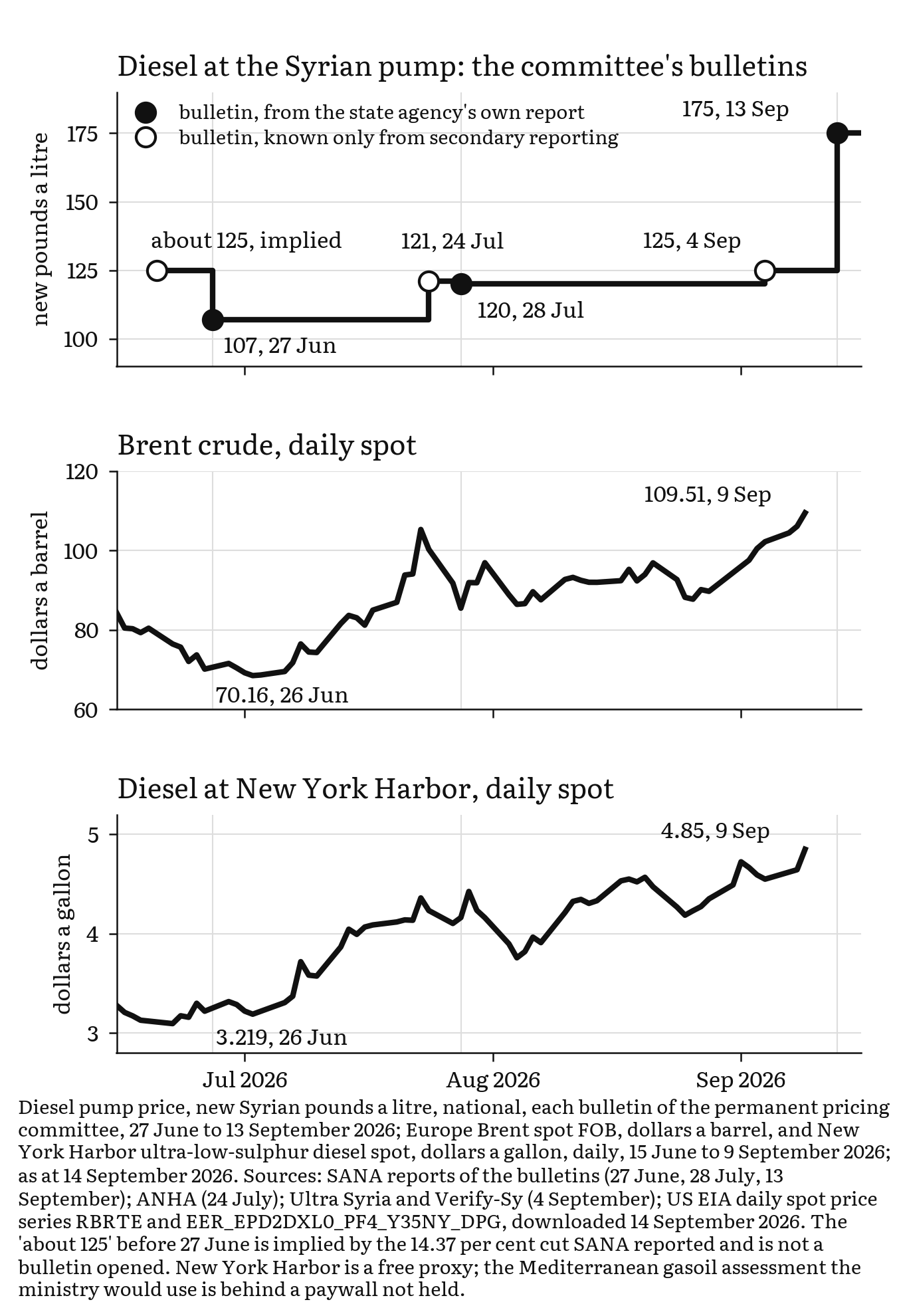
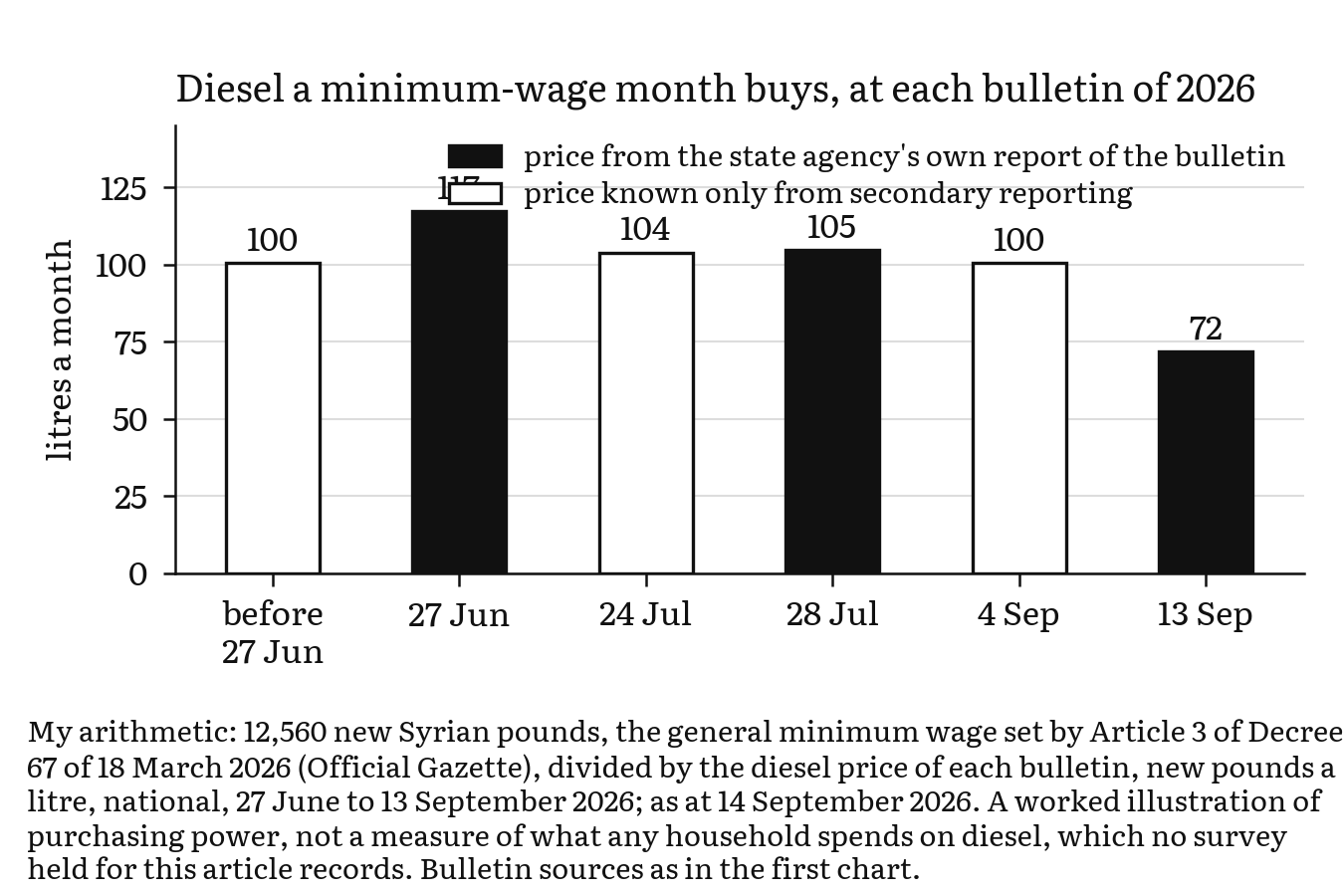
The bulletins have moved as the statement said they would, in both directions. On 27 June the minister approved a cut: diesel down 14.37 per cent to 107. On 24 July, on the Kurdish agency ANHA's report, it stood at 121; on 28 July the committee cut it to 120, "coinciding with the fall in world oil prices". On 4 September it rose five pounds to 125. On 13 September it rose fifty. Six bulletins in eleven weeks, and I have the agency's own report for three of them; the other three rest on secondary reporting and are drawn hollow in the first chart below.
The world price, which the ministry cited and did not show
The ministry's explanation, published through the state agency in the small hours of Sunday, gives the reason as "an exceptional rise in the cost of securing these products globally, coinciding with the overhaul of the Banias refinery". It adds that the rise "is not linked to the crude price alone": refined product markets are under pressure from "damage to refining capacities in Russia and the Middle East, and disruption to supply routes and shipping". It then gives numbers. Diesel "approaches 1,400 dollars a tonne", petrol 1,350, and Brent crude sits "around levels approaching 100 dollars a barrel".
Eleven hours later the same agency, reporting the same ministry, gave Brent as "about 108 dollars at the opening of the week". The United States Energy Information Administration's daily series, which I read on 14 September, has Brent at 104.47 on Monday 7 September and 109.51 on Wednesday 9 September, the last observation before the bulletin. Neither of the ministry's figures is wrong by much. They are not both the number the committee used, and the committee has not said which it used or on what day.
What the series does establish is that the rise tracked the market, and closely. On 26 June, the day before the committee cut diesel to 107, Brent closed at 70.16 dollars. On 9 September it was 109.51, a rise of 56 per cent. Diesel at New York Harbor, the free benchmark I can reach, went from 3.219 dollars a gallon to 4.85, its high for 2026, a rise of 51 per cent. The Syrian pump price went from 107 to 175, a rise of 64 per cent. Those are my divisions. The Mediterranean gasoil assessment a Syrian importer would actually pay against is published by subscription and I do not hold it, so New York is a proxy and the comparison is only as good as a proxy.
So the pump price and the world price moved together, in the same proportion, over the same eleven weeks. That is what a formula would produce. It is also what a committee reacting to the same headlines would produce, and nothing published distinguishes the two. Whether 175 is the right number, rather than a number that moved in the right direction, needs the reference price, the reference rate and the cost stack, and none of the three has been printed.
The exchange rate is the one link that is public. The Central Bank's official bulletin on 14 September gave 122.00 new pounds to the dollar. At that rate diesel at 175 is 1.43 dollars a litre, and at 125 it was 1.03. The ministry's own world price of 1,400 dollars a tonne is about 1.18 dollars a litre before freight, insurance, handling and margin, taking 0.84 kilograms to the litre, which is my assumption and not the ministry's. New York Harbor on 9 September was 1.28 a litre. On those numbers the old price sat below the cost of an imported litre and the new one sits above it. What the difference covers, whether it is the freight and margin the committee's statement lists, a recovery of losses carried since May, or a cushion against the next shipment, is not something anyone has said. The ministry's own description of the purpose is "to preserve the supply financing cycle, from buying a cargo through selling and distributing it to securing the liquidity to buy the next", which is a description of a working-capital problem and not of a price.
How much Syria needs, on the ministry's own figures
The ministry's explanation carries a demand figure. "Syria's need currently reaches approximately 300,000 barrels a day of oil and its derivatives, against local crude production of about 100,000 barrels a day." The media director, Abdulhamid Salat, put it the same afternoon as production covering "about a third of need only", and a fact-checking site quoted him at 300,000 to 325,000.
The same statement then itemises. Daily diesel demand is 7.72 million litres, of which 3.09 million is produced locally and 4.63 million imported. Daily petrol supply is 2.32 million litres, 1.54 million local and 775,000 imported. Household gas supply averages 912 tonnes a day, "with a large reliance on imports". Convert the two liquids at 158.987 litres to the barrel and diesel is 48,557 barrels a day and petrol 14,592, together 63,149. That is 21 per cent of the 300,000 the same statement gives as the country's need. The other 79 per cent, roughly 237,000 barrels a day, is not named. Fuel oil for the power stations will be part of it; in March 2025 the then caretaker energy minister put the plants' daily need at 5,000 tonnes of fuel oil. Jet fuel, bitumen, kerosene and gas will be part of it. But the statement does not say, and a total whose stated components come to a fifth of it is not a total a reader can check.
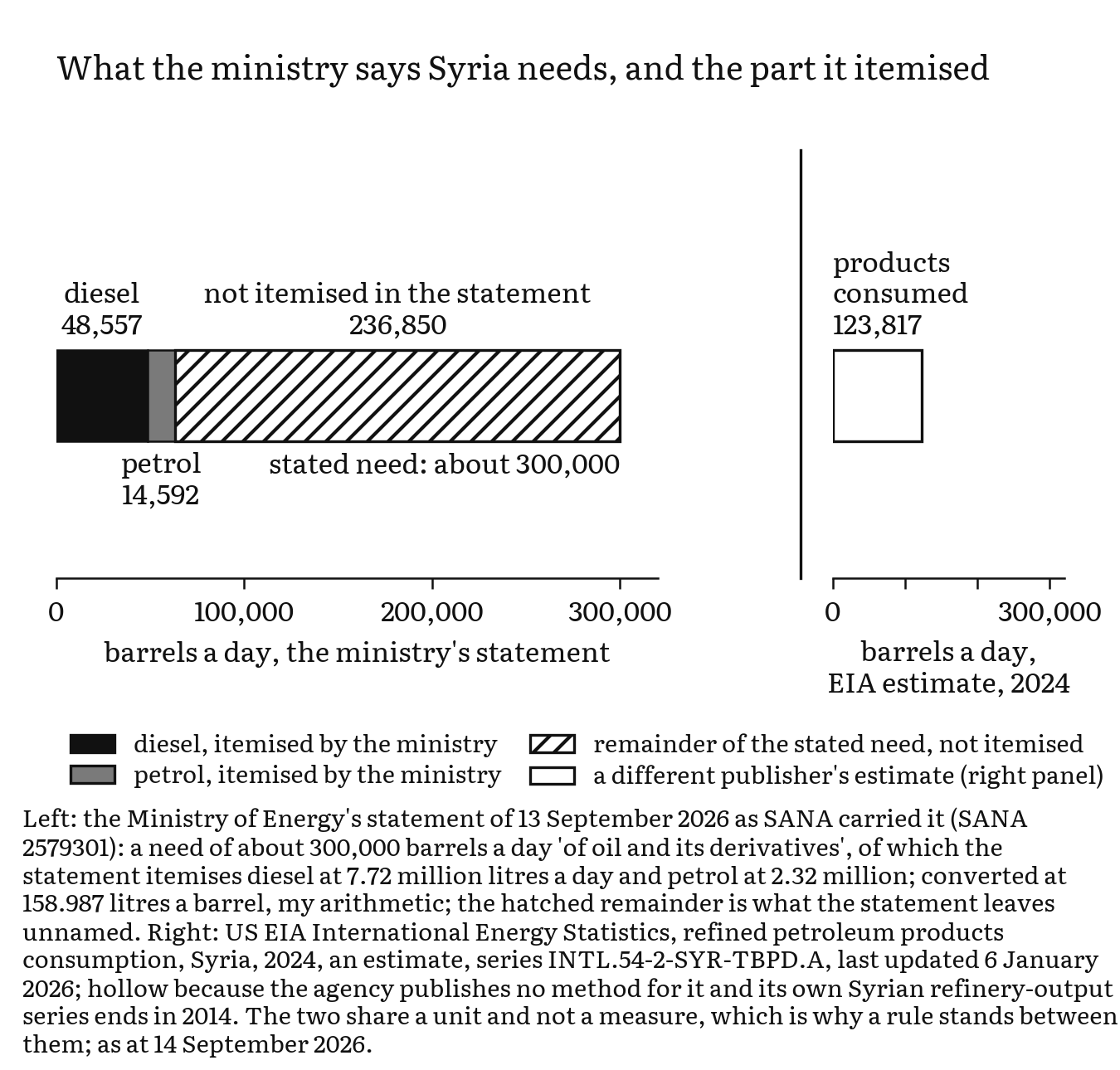
There is a second demand figure in circulation, from a different publisher, and it does not help. The Energy Information Administration estimates Syrian consumption of refined petroleum products at 123,800 barrels a day for 2024, in a series updated in January 2026. That is well under half the ministry's 300,000, and the two are not the same measure: one is products consumed, the other is "oil and its derivatives" needed, which may count crude going into a refinery and the products coming out of it. I put them side by side in the chart with a rule between them for that reason, and I do not subtract one from the other.
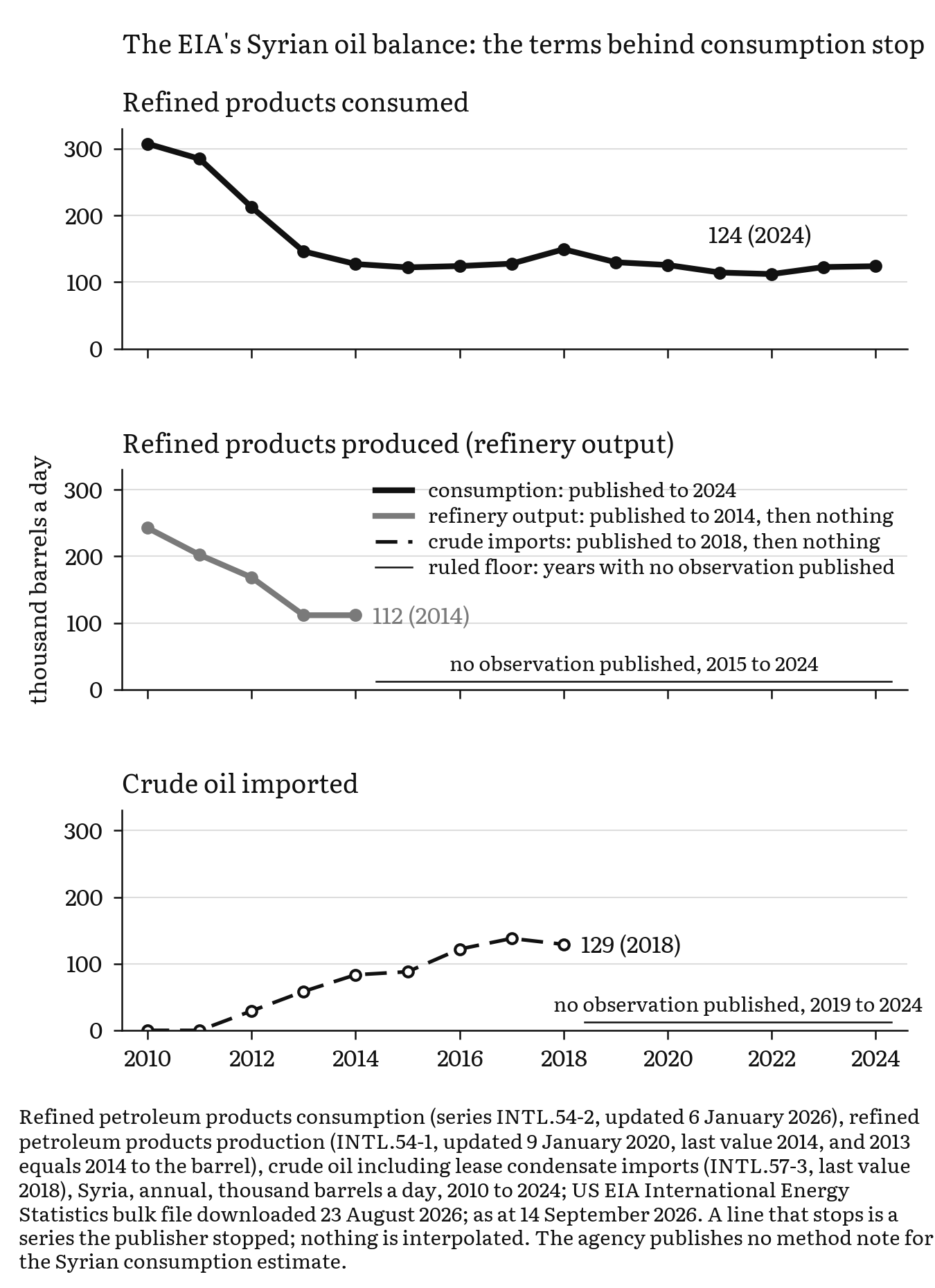
What I can say about the agency's figure is where it sits in the agency's own accounts. A consumption estimate is built from production, imports and exports. The agency's series for Syrian refinery output stops in 2014, at 111,600 barrels a day, and the value it prints for 2013 is the same figure to the barrel. Its series for Syrian crude imports stops in 2018. Its consumption series runs on to 2024 without them. I have not found a method note for how the Syrian consumption figure is arrived at; a search of the agency's international statistics documentation on 14 September turned up general descriptions of estimation where countries do not report, and nothing specific to Syria. The number most often quoted for what Syria consumes is an estimate whose supply columns have been empty for a decade.
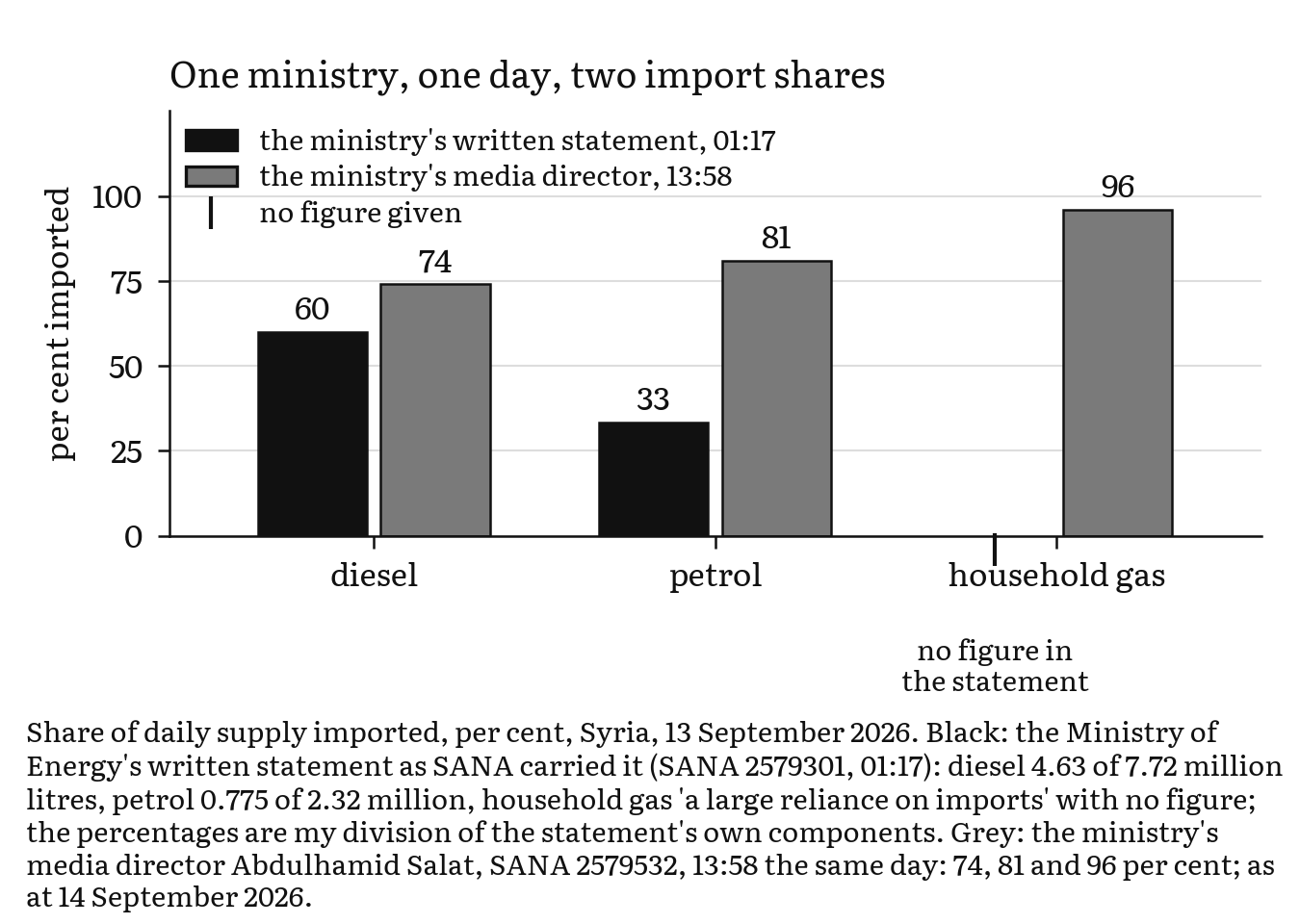
The import shares are where the day's statements contradict each other outright. The written statement's components give diesel imports as 60 per cent of supply, which the statement itself says, and petrol imports as 33 per cent, which is my division of its figures. The media director, on the same day, said Syria imports "about 74 per cent of the market's need for diesel, 81 per cent of petrol, and about 96 per cent of household gas". For petrol the two shares, from one ministry hours apart, differ by a factor of two and a half. One may be a share of need and the other a share of current supply; one may be an annual average and the other the overhaul weeks. Nobody has said, and until somebody does, neither figure is usable.
What is refining, and what the overhaul is
The statement's second reason is the Banias refinery. It "entered a comprehensive overhaul expected to last about two months, which lowers domestic refining capacity during this period and increases the need to buy finished products from external markets". The chief executive of the Syrian Petroleum Company, Yousef Qablawi, is quoted as saying the overhaul's "main objective is to raise the refinery's operating capacity from about 80,000 barrels a day to about 130,000", and that a comprehensive overhaul is "a periodic procedure refineries undergo". The media director described the same event as "a compelled technical overhaul after its technical condition reached a critical stage", and put Homs at "about 30,000 barrels a day".
So the two refineries were running at about 110,000 barrels a day together before Banias went down, adding the two officials' figures, against a combined nameplate the Energy Information Administration put at "slightly less than 240,000" in 2015, the last time it updated its Syria page. Whether the overhaul was scheduled or forced matters for the price because a planned outage can be procured against and a forced one is procured after the fact. The two descriptions from the same ministry point different ways.
There is one more number in the statement, and it may be the most important. "The receivables of the Syrian Petroleum Company from the Syrian Electricity Company during 2026 amounted to about 1.7 billion dollars for gas and energy carriers." One state company is owed 1.7 billion dollars by another for fuel delivered this year. In the book I follow a July 2025 finding by Karam Shaar Advisory that electricity had become the government's largest subsidy expense while sitting outside the budget, because the fuel moves between state entities and is not paid for. This is that finding with a number attached, from the ministry itself. It is a receivable, not a subsidy line, and I do not know its age, its terms or whether any of it is in the 2026 budget. But a fuel company owed 1.7 billion dollars by its largest customer has a working-capital problem, and a working-capital problem is what the ministry says the price rise exists to solve.
What the book already established, and what this week adds
Three findings from the book bear directly on this week and are unchanged by it.
The first is that Syrian production figures are not one quantity. Chapter 8 of the forthcoming book, on gas: "So the range is not a range of estimates of one quantity. It is a set of differently defined quantities laid side by side, and setting 7.4 against 8 as rival estimates is the error rather than the disagreement." The Syrian Petroleum Company's own director of oil field management has said the company does not have precise figures on the number of oil wells in Syria, while the same company publishes that 40 per cent of wells are operating. "A percentage of an unknown denominator is not a measurement." The ministry's 100,000 barrels a day of crude this week sits beside the World Bank's two figures for 2024, 54,153 in the dataset behind its flaring tracker and 63,000 in its macro-fiscal assessment, of which the book says "neither publication mentions the other, and a reader of either alone cannot see both".
The second is that no Syrian institution publishes the numbers. In August I approached the Syrian Petroleum Company, the phosphate company, the Ministry of Energy and its predecessor ministry by every route I could run. "None of the six publishes production, reserve or contract data by any route I can run." The figures above reached the public because the ministry put them in a press statement on the day it raised prices, and no schedule for updating them has been announced.
The third is about subsidy reform. "Fuel subsidies were liberalised in stages across 2025: transport fuel in January, diesel and gasoline in March, cooking gas in July. No source opened for this chapter records a targeting mechanism or a compensating cash transfer accompanying any of the three." The chapter goes on: "A subsidy removed without the instrument that protects the poorest from its removal is not half a reform. It is a different reform, with different politics." An energy ministry source told Enab Baladi in May 2026 that the treasury was still losing over 219 million dollars a month on fuel, 135 million of it on diesel. Whether the loss on diesel is now zero at 175, or negative, is a question the ministry could answer in one line and has not.
What this week adds is the protection layer, and it is thinner than it was when those chapters were written.
Who pays
The only targeted programme the book could find between a Syrian household and a freed price was not the state's. The World Food Programme launched a subsidised bread scheme in June 2025, supplying fortified flour to bakeries in the governorates it judged most vulnerable, and by early 2026 it reached about four million people a day through more than 300 bakeries. On 13 May 2026 the agency announced it had suspended the scheme for want of funding, halved its emergency food assistance from 1.3 million people to 650,000, and was cutting coverage from fourteen governorates to seven. Its country director said the reduction was "driven solely by funding constraints, not by a decrease in needs". So when diesel rose forty per cent on 13 September, the one instrument that had been shielding the poorest from the price of bread had been gone for four months.
I looked for anything that accompanied the bulletin. The state agency's reports of 13 and 14 September, the ministry's two explanations, the fact-checking site's account and one search of the Arabic press for a compensating payment, a wage step or a fare adjustment turned up none. What they turned up was the freight director saying his ministry "is preparing a full study of the reality of goods transport fares" and would "raise the matter to the relevant bodies". A study is not a transfer. That is a bounded absence in those sources on those two days, and I state it as such; a measure announced later would change it.
What the price means for a household I can only illustrate, because nobody has measured it. The general minimum wage is 12,560 new pounds a month, set by Article 3 of Decree 67 of 18 March 2026, which I have read in the Official Gazette. A month of it bought 100 litres of diesel at 125 and buys 72 at 175. A household gas cylinder at 1,600 is 12.7 per cent of it. Those are my divisions and they are a worked example of purchasing power, not a statement of what any household spends, because no published household survey of Syrian fuel spending since the subsidies were freed appears in any source opened for this article, and I have not searched for one beyond them. The World Bank's April 2026 outlook gives poverty at 20.9 per cent of the population below 3 dollars a day and 46.8 per cent below 4.20 for 2025, and its own footnote says those are projections from a 2022 distribution with an assumed pass-through, not measurements. A price rise of this size has landed on a population whose poverty is estimated by formula.
The book takes a position on the order in which these things should happen, and I will quote it rather than restate it, because the wording was argued over. Chapter 11 finds that the existing social safety net "cannot be sized from the evidence available, because the only budget share published for it is the combined 41 per cent above, in which social protection is not separated", and continues: "A recommendation to expand a net whose current size is unpublishable is a recommendation whose cost this book cannot state, and I do not state one. What I state is an order: retrenchment and tariff reform come after a transfer mechanism is demonstrably operating, with coverage, payment and grievance data published, and where that demonstration is not available the fallback is to delay the dismissals or the tariff change rather than to proceed and call the harm transitional."
That was written about electricity tariffs and public-sector retrenchment. It applies to diesel without alteration. The committee's remit names "support mechanisms" as a factor it weighs. If one exists, it has coverage, a payment channel and a budget line, and those fit in a paragraph. If it does not, the word in the remit is doing no work, and the bulletin of 12 September was a price rise on a population with nothing between it and the price. The ministry says the rise is temporary. A household does not buy diesel on a temporary basis.
What is known, what is not, and what is not published
| Question | What the record holds | What would answer it |
|---|---|---|
| What is the pump price? | Six bulletins, June to September 2026; three from the agency's own reports, three from secondary reporting | The committee's bulletins published as a series, with dates |
| How is it set? | A list of nine factors; no formula, reference price, reference rate or cost stack | The "bases and standards" Decision 844 says the committee will set |
| What was the world price used? | "Around 100" and "about 108" for Brent, from one ministry on one day; EIA has 104.47 and 109.51 that week | The date and the assessment the committee priced against |
| What does Syria need? | About 300,000 barrels a day, of which 63,000 is itemised; EIA estimates 124,000 products consumed, without the balance behind it | A published monthly product balance: production, imports, stocks, sales |
| How much is imported? | 60 per cent of diesel and 33 per cent of petrol on the statement's figures; 74 and 81 on the media director's | The measure each share is a share of |
| What are the refineries doing? | Homs about 30,000; Banias about 80,000 before the overhaul, 130,000 targeted; nameplate about 240,000 in 2015 | Throughput by month, and whether the overhaul was scheduled |
| What does the treasury lose or gain at 175? | 219 million dollars a month in May, from an unnamed source; nothing since | A published subsidy line, monthly, by product |
| Who owes whom for fuel? | 1.7 billion dollars owed by the electricity company to the petroleum company for 2026 | The receivable's age, terms and budget treatment |
| Who is protected? | No state transfer found with the bulletin; WFP's bread scheme suspended since May | The mechanism, its coverage, its payments |
| What does a household spend? | Nothing measured since the 2025 liberalisation; poverty rates are projections | A household survey |
Questions for Thursday
The energy minister appears before the People's Assembly on 17 September. These are the questions the record does not answer, in the order I would ask them.
- Which world price, on which date, did the committee price the 13 September bulletin against, and at what exchange rate?
- What is the cost of an imported litre of diesel delivered to a Syrian depot today, item by item, and what does 175 leave after it?
- Of the 300,000 barrels a day the ministry says Syria needs, what are the components beyond the 63,000 of diesel and petrol it named?
- Is the share of diesel imported 60 per cent or 74 per cent, and what is each a share of?
- Was the Banias overhaul scheduled, and if so when was it scheduled and why was it not procured against?
- What is the 1.7 billion dollars the electricity company owes the petroleum company, how old is it, and is any of it in the 2026 budget?
- What is the "support mechanism" in the committee's remit, whom does it reach, and through which channel?
- When does temporary end, and who decides?
None of these needs new data. Each is a number the ministry already holds, or a decision it already took.
What would change the answer
A published pricing formula, with its reference price and rate, would let anyone who can multiply check a bulletin against the market on the day it was issued. A monthly product balance, production and imports and sales by product, would turn the ministry's 300,000 into a figure with components. A subsidy line in the budget, by product, would say what the treasury is spending or recovering at any price. And a transfer mechanism with published coverage would let the committee raise a price in a bad week without the road closures that followed this one, because the people the price falls hardest on would know what stood between them and it.
None of those is a programme. Each is a document, and each is a document the state already has the information to write. In the book I put it this way, about oil revenue: "A state that publishes what it received can be argued with. A state that publishes a total cannot." The same is true of a state that publishes a price.
The forthcoming book is The Numbers That Do Not Hold; passages quoted from it are from its current approved chapters and may change before publication.
Further reading
- Ensuring Social Services in Syrian Public Sector Reform Post-Assad
The sequencing rule this piece quotes from the book, a transfer mechanism demonstrably operating before the price or the payroll moves, argued in full for public-sector retrenchment.
- The Role of the State Budget in Post-War Syrian Reconstruction: Lessons from the UK and Beyond
Why a published subsidy line by product matters: the budget as the state's statement of priorities, and what Syria can take from how the UK and Rwanda built theirs.
- The Fiscal Calculus of Syria’s Post-Assad Reconstruction
The exchange-rate and fiscal-space constraints behind a working-capital problem at the petroleum company, set out at the level of the whole reconstruction.
Related posts
Better Than Assad Is the Minimum, Not the Dream
One argument recurs constantly in Syrian conversation today, and it is true in much of what it claims: "there are problems, but things are better than they were under Assad". The problem begins the moment it stops describing reality and starts answering every question. This piece separates the question of how far we have come from the question of where we are going, distinguishes rights that need capacity from rights that need only a decision, and sets out a floor of demands that needs no budget and no ten years.
The Confidence Tax: Why Reviving Syria's Ottoman Endowment Records Will Cost More Than It Recovers
An analysis of the Syrian Ministry of Endowments' plan to reclaim historic waqf properties using Ottoman archives. Explore why reopening century-old title deeds acts as a tax on property confidence, undermining post-conflict reconstruction and urban recovery.
The Qasyoun Journey Project and the Pattern It Sets
On 21 April 2026 the Damascus Governorate and the Ministry of Tourism launched "Qasyoun Journey", a tourism and heritage megaproject on Mount Qasyoun, prepared by "a team of specialised designers" with no open tender, no published brief, no costing and no impact studies. It is the second time the new Syrian authorities have commissioned a symbolic national asset behind closed doors and framed it as a national gift. This piece tests the official claims, asks whether the public or the investors are being misled, and sets out what a serious course correction would look like.