Walk Forward Optimization Is Not Automatically Out of Sample
Everyone sells walk-forward validation as proof a strategy is out-of-sample. It is not. I ran my own walk-forward pipeline on pure random-walk noise and it still produced a healthy positive stitched Sharpe, because out-of-sample is a property of provenance, not partitioning. Here is the random-walk control that tells you whether your pipeline, or your edge, produced the number.
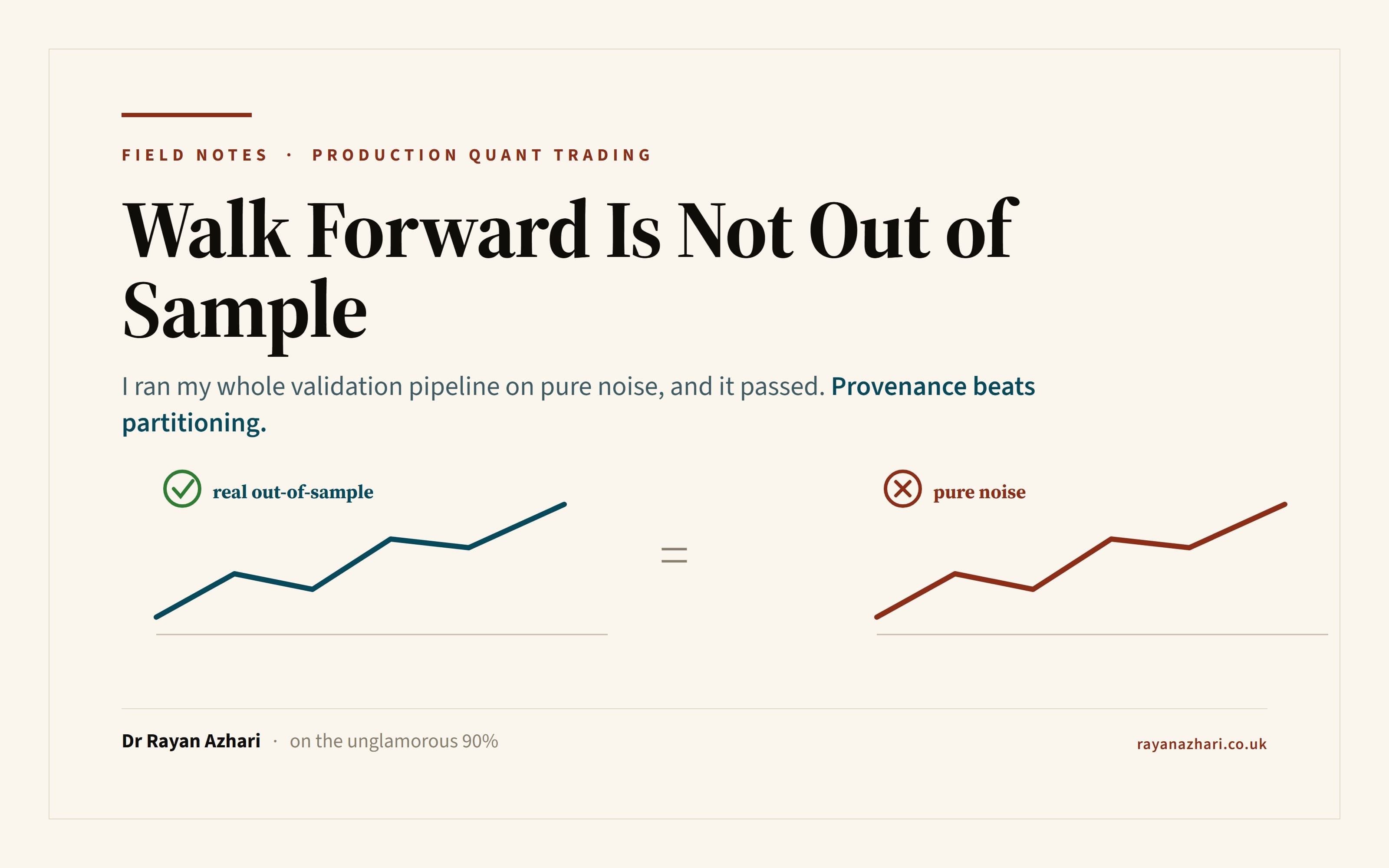
I once ran my whole walk-forward pipeline on pure noise, and it passed.
Not marginally. I fed a synthetic random walk, a price series with no edge by construction, into the identical machinery I use to earn a real strategy its deployment ticket: sweep a grid of lookbacks, keep the winners, slide the window, stitch the out-of-sample segments into one equity curve, bootstrap a confidence interval. The number that came out the far end was a stitched out-of-sample Sharpe comfortably above one, with a lower bound clear of zero. On a coin toss. If I had not known the input was noise, that curve would have walked straight through my deployment gate and I would have sized real capital against an edge that did not exist.
That is the essay in one experiment. Walk-forward optimisation is sold, almost universally, as the thing that makes a backtest honest: train on the past, test on the future you could not see, repeat. And it can be exactly that. But the folds and the stitched curve and the tidy confidence interval are not what make a window out-of-sample. I had all three, on noise. What makes a window out-of-sample is something the artefacts cannot show you, and it is the thing I want you to leave with.
Out-of-sample is a property of provenance, not partitioning
Here is the sentence I wish someone had made me tattoo on the inside of my eyelids before I built any of this: a held-out window is out-of-sample only if the parameters you are testing on it were fixed before anyone looked at that window.
Splitting your data into an in-sample block and a later out-of-sample block feels like it does the work. It does not. The split is necessary and nowhere near sufficient. "Later in time" is not the same as "unseen by the search." If my grid sweep looked at the whole price history, chose the lookback that scored best across all of it, and only then drew fold boundaries around that already-chosen winner, every out-of-sample window is being scored with a parameter that was optimised on data including that very window. The bars are later. The information is not new. The selection already peeked.
This is why I distinguish, ruthlessly, between two things that produce byte-identical artefacts:
- A true walk-forward, where the parameter choice on each fold used only that fold's in-sample window, or was pre-registered before any data was examined. The out-of-sample segments carry genuine predictive evidence.
- A stability scan, where one configuration, chosen with knowledge of the whole series, is checked across sub-periods. This answers a real and useful question ("does this one config hold up across regimes?"), but it carries zero out-of-sample evidence, because the config already saw every period it is now being "validated" on.
A stability scan is not an insult. It is a legitimate tool. The cardinal sin is dressing one up as the other, because the moment you call it out-of-sample, every downstream gate you own, the bootstrap interval, the deflated Sharpe, the Monte Carlo, inherits a number that was contaminated at source and launders it into something that looks trustworthy.
The tell is invisible in the output
The reason this trap is so durable is that the contamination leaves no fingerprint on anything you would normally inspect. Both procedures give you folds. Both give you a stitched equity curve sloping up and to the right. Both give you a confidence interval, and here is the genuinely dangerous part: on a curve-fit-then-fold series, that interval is tight and positive, because the returns it is resampling really did happen under parameters that really did fit. The arithmetic is honest. The provenance is fake. You cannot eyeball your way to the difference, because the only thing that separates a real walk-forward from a laundered stability scan is the order in which two events happened, the parameter choice and the data look, and that ordering is nowhere in the chart.
Chart
Identical noise, two pipelines
Share of runs on a pure random walk (no edge by construction) whose stitched out-of-sample lower bound clears zero, a false pass. Only the provenance of the parameters differs. Illustrative and sanitised.
Which is exactly why I stopped trying to catch it by reading and built a control that catches it mechanically.
The portable artefact: run your pipeline on noise
If you take one thing from this piece, take this. It is the cheapest, most brutal validation test I own, and it fits in an afternoon.
Run your entire walk-forward pipeline, unchanged, on a pure random walk. If it still "passes," your pipeline is the edge, not the strategy.
That is the whole test. Generate a synthetic price series with no predictability, a driftless random walk, and feed it through the exact same code path your real strategies go through: same grid, same fold geometry, same stitching, same bootstrap gate. Do not simplify it. Do not run a "representative" version. Run the real thing, because the whole point is to indict your procedure, and any shortcut lets the procedure off the hook.
Then read the verdict:
- If your pipeline selects parameters per fold, on in-sample data only, the random walk collapses to a stitched out-of-sample Sharpe near zero, with a lower bound straddling zero. A correct reject. The pipeline found nothing in nothing, which is the only right answer.
- If your pipeline sweeps the whole series, keeps the best cell, and draws folds around it afterwards, the same noise hands you a confidently positive stitched Sharpe with a lower bound above zero. A false pass, manufactured entirely by the selection step.
The gap between those two verdicts, on identical noise, is the exact size of the lie your procedure is capable of telling. And crucially, it is a property of your code, not of any particular strategy. Once you have measured it on noise, you know how much of any real result to distrust.
Figure
Two procedures, byte-identical artefacts
Both give folds, a rising stitched curve, and a tight confidence interval. Only one carries out-of-sample evidence.
True walk-forward
carries OOS evidence
Each fold's parameters use only that fold's in-sample window, or are pre-registered before any data is seen. The out-of-sample bars were never touched by the search.
Stability scan in disguise
carries zero OOS evidence
One config, chosen with sight of the whole series, checked across sub-periods. Useful, but the parameters already saw every window they are now validated on.
Out-of-sample is a property of provenance, not partitioning.
I keep a version of this control wired in permanently. Every so often the random-walk input runs through the pipeline and the assertion is simple: the stitched out-of-sample lower bound must not clear zero. The day it does, something in the selection path has started peeking, and I would rather find that out against synthetic noise than against my savings.
Where the leak actually gets in
The random-walk control is the detector. It is worth knowing the two places the contamination usually enters, because they are both mundane and both easy to ship without noticing.
The first is the obvious one: selecting on the whole series. You sweep a grid over all your history because that is the natural thing to do in a notebook, you note the best lookback, and later you build a walk-forward "to validate it." The validation is already dead on arrival. The winner was chosen with sight of every fold. The fix is discipline about ordering: either re-select the parameter inside each fold using that fold's in-sample window only, applying it unchanged to the out-of-sample bars and re-selecting from scratch as the window slides, or pre-register the exact grid and the exact winner-picking rule before the data is run, so a single out-of-sample pass counts because the choice is provably older than the look.
The second is quieter and I have shipped it myself: normalising across the boundary. Even a structurally correct walk-forward leaks if you z-score a feature using statistics computed over the whole fold, in-sample plus out-of-sample together. Now every in-sample bar's normalised value secretly knows the out-of-sample mean and standard deviation. The fold partitioning is intact; the future has walked in through the feature pipeline. The rule is to freeze the normalisation statistics on the in-sample window and apply them, frozen, to the out-of-sample window, and to offer no full-series version of the function that could do it by accident. The test I like is savage in its simplicity: append out-of-sample bars drawn from a wildly different distribution, and the in-sample slice's normalised values must come back byte-identical. If poisoning the future changes the past, you have a leak, and the random-walk control will usually be the thing that catches its downstream effect.
Why "later in time" seduces everyone
The deep reason this fools careful people is that we conflate two senses of "the model has not seen this data." Chronological novelty (the bars come from a later date) feels like informational novelty (no decision in the search used these bars). They are not the same, and only the second one earns you an out-of-sample claim. A window from next year that your parameter search nonetheless consulted, because the search ran over the whole series, is chronologically fresh and informationally stale. It tells you nothing you did not already bake in.
So the question I now ask of every walk-forward result, my own included, is not "are the test windows later?" It is the harder one: did any decision in the entire search, from grid boundaries to the winner rule to the feature normalisation, ever touch these bars? If the answer is yes anywhere, the window is not out-of-sample, however late it falls on the calendar. Provenance, not partitioning. And when I cannot fully trust my own answer to that question, I let the random walk answer it for me, because noise has no edge to find, so anything my pipeline "finds" in it is the pipeline confessing.
The takeaway
A walk-forward is not out-of-sample because you split the data and slid a window. It is out-of-sample only if the parameters were fixed before the window they are scored on was ever examined, per fold on in-sample data or pre-registered before the run. Everything else is a stability scan wearing the costume, and its confidence interval is a tight, positive, entirely fake reassurance. You cannot catch the difference by reading the chart, because the contamination leaves no mark on the artefacts. So stop trying to read it, and build the control: push pure noise through your real pipeline, and if it still passes, you have measured your own procedure's capacity to lie. That number, not the pretty curve, is what tells you how much of your next result to believe.
The full method, per-fold selection versus pre-registration, freezing normalisation at the boundary, and gating on the stitched out-of-sample bootstrap lower bound, is laid out in the free chapter, Walk-forward that's actually out-of-sample, which is free to read as part of the open second part of Building a Production Quant Trading System; the complete book, a living digital copy on Leanpub and a print paperback on Amazon, goes on through position sizing, portfolio construction and operating the system live. If these field notes are useful, the newsletter carries the next one the week it publishes.
This is an engineering essay, not investment advice, and it contains no tradable strategy. All figures are illustrative and sanitised, and every war-story here is about a bug I caught, never a profit I made.
Chart
Identical noise, two pipelines
Share of runs on a pure random walk (no edge by construction) whose stitched out-of-sample lower bound clears zero, a false pass. Only the provenance of the parameters differs. Illustrative and sanitised.
Figure
Two procedures, byte-identical artefacts
Both give folds, a rising stitched curve, and a tight confidence interval. Only one carries out-of-sample evidence.
True walk-forward
carries OOS evidence
Each fold's parameters use only that fold's in-sample window, or are pre-registered before any data is seen. The out-of-sample bars were never touched by the search.
Stability scan in disguise
carries zero OOS evidence
One config, chosen with sight of the whole series, checked across sub-periods. Useful, but the parameters already saw every window they are now validated on.
Out-of-sample is a property of provenance, not partitioning.
Further reading
- The Deflated Sharpe Ratio: Why Your Grid-Search Winner Is Probably Noise
Its companion overfitting piece: deflation prices the multiple-testing penalty that a contaminated walk-forward hides.
- Suspicion Over Celebration: Inside "Building a Production Quant Trading System"
Walk-forward that is actually out-of-sample is one chapter of the free half; the book review lays out the full guide.
Related posts
Risk of Ruin Monte Carlo: Resample the Cause, Not the Effect
Most risk-of-ruin Monte Carlo resamples a strategy's realised P&L, which quietly bakes in the good luck you are trying to stress and understates the tail. Here is the correction that made my honest drawdown distribution far fatter than my first one, plus the relative gate a long-only sleeve actually needs. First person, British English, illustrative numbers only.
Look-Ahead Bias in a Backtest: The Corrupt-the-Future Test That Catches It
Look-ahead bias is the default state of careless backtest code, not an exotic edge case, and it survives review because it reads as ordinary pandas. Here is the corrupt-the-future causality test I now gate on: poison every price after a date, then assert nothing computed before it moves. If the past shifts when you poison the future, the strategy is reading ahead.
Bar Timestamp Convention: The Open vs Close Stamp That Leaks a Full Bar of Look-Ahead
A bar carries one timestamp, but that stamp is ambiguous: is a bar labelled 09:00 the open of the coming interval or the close of the last one? Vendors disagree, and reading the wrong edge is a clean one-bar look-ahead that sails through review. Here is the war-story, why the leak is invisible, and the ingest rule I now enforce on every feed.