Look-Ahead Bias in a Backtest: The Corrupt-the-Future Test That Catches It
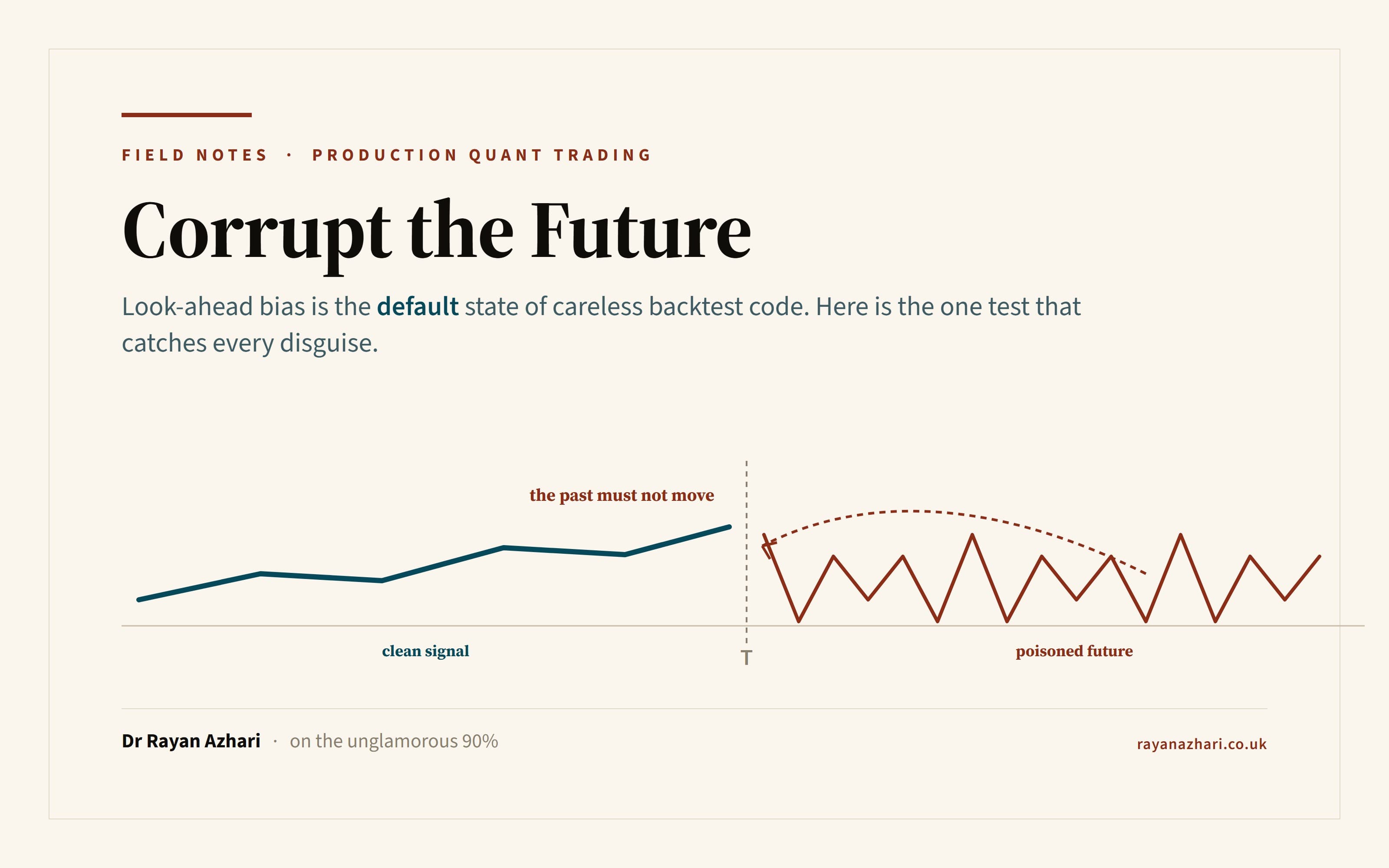
Look-ahead bias is the default state of careless backtest code, not an exotic edge case, and it survives review because it reads as ordinary pandas. Here is the corrupt-the-future causality test I now gate on: poison every price after a date, then assert nothing computed before it moves. If the past shifts when you poison the future, the strategy is reading ahead.
The first time I truly believed look-ahead bias was the default state of my code, not a rare accident, was an audit of one regime-driven corner of Titan, my live multi-strategy system. I went looking for a single leak and found the same bug in four separate files. Each one multiplied a signal by a return that had already happened. Each one read as perfectly ordinary pandas. Collectively they had turned a flat strategy into a stellar one, and not one of them had been flagged in review. That is the thing nobody tells you: look-ahead is not an exotic failure mode you occasionally stumble into. It is what careless code does by default, and it hides in plain sight because it produces a curve that looks exactly like success.
This piece is about why that is structurally true, the costumes the bug wears, and the one test I now trust more than any amount of careful reading: corrupt the future, and check that the past does not flinch.
Why look-ahead is the default, not the exception
A backtest is a simulation of decisions made through time with only the information available at each moment. But the tools we write it with, pandas, numpy, a dataframe of the whole history sitting in memory, have no concept of "now". Every column already contains the future. x.mean() sees every bar. momentum.idxmax() sees today's close. A .where() aligns two series without caring which one was knowable first. The machinery is built to see everything at once, so the natural thing to type is the thing that peeks. You have to actively fight the grain of the library to write causal code, and if you do not fight it, the future leaks in for free.
That is why look-ahead survives review. It is not disguised as something suspicious. It is disguised as competence. A leaked backtest and an honest one differ by a single .shift(1) buried in the middle of a line that otherwise looks completely reasonable. The reviewer's eye slides over it, because there is nothing there to catch on.
Chart
One .shift(1) is the whole difference
The same-bar collect, where a position earns the very bar that chose it, manufactures a plausible but fake curve; the .shift(1) version on the identical data is flat. Illustrative and sanitised.
The costume I have shipped most often is the "same-bar collect". You decide a position using bar t, then earn bar t's return with it:
# WRONG: `winner` is chosen using close[t]; `ret` is the return INTO close[t].
winner = momentum.idxmax(axis=1)       # knowable only AT close t
strat  = ret.where(columns == winner)  # but ret already happened by close t
The position was chosen with information that includes the very bar it then profits from. Because momentum is autocorrelated, this manufactures a gorgeous, plausible, completely fake equity curve. The fix is one lag:
winner_lag = winner.shift(1)               # decide on yesterday's info
strat = ret.where(columns == winner_lag)   # earn today's return
One character of difference between a licence to print money and a flat line. That is the whole problem in miniature.
The other disguises
Same-bar collect is the loudest, but look-ahead has a wardrobe. Three more I check for by reflex:
Full-series normalisation. Standardising a feature is routine, and the routine version peeks by construction:
z = (x - x.mean()) / x.std() # mean and std computed over the ENTIRE series
At every historical bar, that z-score already knows the mean and standard deviation of data that had not happened yet. It never touches a return directly, which is what makes it insidious: it poisons the feature, and the damage flows downstream into whatever signal the feature feeds. The cure is a causal or expanding window, or freezing the statistics on your in-sample slice and applying them unchanged out of sample.
The forward-filled higher-timeframe signal. You compute a signal on daily bars, then join it onto an hourly frame and forward-fill. Do it carelessly and the daily value for a given day becomes available on that day's first hour, hours before the daily bar it was computed from has actually closed. The signal time-travels back to the morning. This one is nasty because the leak is measured in hours, invisible on a chart, and only appears when you line up the exact timestamp the daily bar became knowable against the timestamp you started acting on it.
A smoother where you needed a filter. A centred moving average, a Savitzky-Golay smoother, an offline Hodrick-Prescott, a scipy.signal.filtfilt pass: every one of these uses future samples to compute the value at the current point. They are wonderful for drawing a clean line on a chart of the past and catastrophic as a live signal, because the "current" value literally depends on points to its right. If your indicator library offers a two-sided smoother, assume it looks ahead until you have proven the implementation is causal.
Notice the common thread. None of these looks like cheating. Each reads as a sensible, even tasteful, piece of numerical code. That is precisely why you cannot proofread your way to safety. You need a test that does not care how reasonable the code looks, only whether information flows backwards in time.
The portable artefact: corrupt the future
Here is the test I want you to keep. It is framework-agnostic, it fits in a few lines, and it does not care what your strategy does internally. The principle is a definition of causality itself: nothing you compute at or before time T is allowed to depend on any price after T. So test exactly that.
Take your price series. Pick a cut date T somewhere in the middle. Compute your signal, or your position, or your whole feature matrix, on the clean data and keep the slice up to T. Now make a poisoned copy of the same series in which every value strictly after T is corrupted: overwrite it with noise, multiply it by ten, reverse it, replace it with zeros, anything wildly different. Recompute the same quantity on the poisoned series and take its slice up to T. Then assert the two slices are identical.
Figure
The corrupt-the-future test
A framework-agnostic causality check: nothing computed at or before T may depend on a price after T.
- 1
Pick a cut date T
somewhere in the middle of the price series
- 2
Compute on CLEAN data, keep the slice up to T
a signal, a position, or the whole feature matrix
- 3
Poison every price strictly AFTER T
multiply by noise, reverse it, or zero it
- 4
Recompute on the POISONED data, keep the slice up to T
- 5
Assert the two pre-T slices are identical
if the past moved, the leak is at the first divergent bar
It does not ask whether the code looks causal. It asks whether the answer changes when you change data that should not be visible yet.
def assert_no_lookahead(compute, prices, cut, rng):
    # compute(prices) -> a series/frame indexed like prices (signal, position, feature)
    clean = compute(prices)

    poisoned = prices.copy()
    future = poisoned.index > cut
    poisoned.loc[future] *= (1 + rng.normal(0, 5, future.sum()))  # wreck the future

    dirty = compute(poisoned)

    before = prices.index <= cut
    # Nothing computed at or before the cut may move when only the future changed.
    pd.testing.assert_series_equal(clean[before], dirty[before])
If that assertion passes, the past genuinely does not know the future, for this cut. If it fails, you have not just a suspicion but a located leak: the first index at which clean and dirty diverge before the cut is the exact bar where the future first bled backwards. Run it across a handful of random cut dates and several corruption styles, and wire it into CI so it runs on every strategy before promotion. It costs milliseconds and it is brutally hard to fool, because it does not ask "does this code look causal?" It asks the only question that matters: "does the answer change when I change data that shouldn't be visible yet?"
The beauty is that it is total. It does not care whether the leak lives in a .shift() you forgot, a full-series .mean(), a forward-fill, a two-sided filter, or somewhere in a dependency you have never read. Any path by which future prices reach a past value trips the same wire.
The war story that sold me on it
The catch that made this test permanent in Titan was a regime model. I was decoding market states with a hidden Markov model, and the decode step used the forward-backward algorithm, a Viterbi-style smoother that produces the most probable state sequence given the entire observation series. Which is to say: the inferred regime at a given day was computed using every day that came after it. Read offline on historical data it is the correct, maximum-likelihood answer. Deployed as a signal it is pure look-ahead, because today's regime label depended on next week's prices.
I would probably have argued myself out of seeing this. The code was textbook, the library was respectable, and "most probable state sequence" sounds like exactly what you want. But I did not have to argue. I ran corrupt-the-future on the regime series, poisoning prices after a mid-sample cut, and the regime labels before the cut changed. The test failed in seconds and pointed at the decode step. The fix was to switch from the smoothed (forward-backward) decode to a filtered one that conditions only on data up to each point, and to re-run every downstream number. No amount of staring at the decode call would have surfaced that; a poisoned copy of the data surfaced it immediately.
That is the general lesson from every look-ahead leak I have shipped, the four same-bar collects included. None of them was caught by re-reading the code, because the same blind spot that wrote the bug reads the review. Each one fell to an external, mechanical check that asked the question my attention had already skipped. Careful reading is necessary and it is not sufficient. The test is what actually holds the line.
So carry this out of here: treat any position * return as guilty until you have proven the position was knowable strictly before the return's window opened, and make corrupt-the-future a gate every strategy clears before it sees capital. Look-ahead is not the exception your code occasionally makes. It is the default your code escapes only when you force it to.
The full chapter this grew out of, A backtest you can trust, is free to read: it walks the five ways a backtest lies, the shift discipline in detail, and why Titan routes every metric through one module where the unsafe version simply does not exist. You can see a sanitised, runnable version of the causality test and the layout it lives in on GitHub, which is Apache-2.0. That chapter is part of Building a Production Quant Trading System; the complete book, a living digital copy on Leanpub and a print paperback on Amazon, carries the paid half on sizing, portfolio construction and running the system live. If these field notes are useful, the newsletter is where the next one lands.
This is an engineering essay, not investment advice, and it contains no tradable strategy. All figures are illustrative and sanitised, and the war-stories are about bugs, not profits.
Chart
One .shift(1) is the whole difference
The same-bar collect, where a position earns the very bar that chose it, manufactures a plausible but fake curve; the .shift(1) version on the identical data is flat. Illustrative and sanitised.
Figure
The corrupt-the-future test
A framework-agnostic causality check: nothing computed at or before T may depend on a price after T.
- 1
Pick a cut date T
somewhere in the middle of the price series
- 2
Compute on CLEAN data, keep the slice up to T
a signal, a position, or the whole feature matrix
- 3
Poison every price strictly AFTER T
multiply by noise, reverse it, or zero it
- 4
Recompute on the POISONED data, keep the slice up to T
- 5
Assert the two pre-T slices are identical
if the past moved, the leak is at the first divergent bar
It does not ask whether the code looks causal. It asks whether the answer changes when you change data that should not be visible yet.
Further reading
- Your Backtest Is Not Evidence: Why Retail Quant Systems Die Before They Trade
The manifesto: a leaked backtest is the archetypal flattering-but-fake curve, caught only by an independent mechanical check.
- Suspicion Over Celebration: Inside "Building a Production Quant Trading System"
The corrupt-the-future test is one of the disciplines in A backtest you can trust; the book review lays out the full guide.
Related posts
Walk Forward Optimization Is Not Automatically Out of Sample
Everyone sells walk-forward validation as proof a strategy is out-of-sample. It is not. I ran my own walk-forward pipeline on pure random-walk noise and it still produced a healthy positive stitched Sharpe, because out-of-sample is a property of provenance, not partitioning. Here is the random-walk control that tells you whether your pipeline, or your edge, produced the number.
The Deflated Sharpe Ratio: Why Your Grid-Search Winner Is Probably Noise
The expected best Sharpe of a parameter sweep climbs as the grid grows, even when every strategy in it is worthless. Here is the deflated Sharpe ratio explained as a practitioner sees it, with a small N to noise-ceiling lookup table you can apply to your own sweep tonight, and the one rule that killed my proudest grid-search winner: N is the pool, not the podium.
Adjusted vs Unadjusted Close: The Dividend Double-Count That Fakes a Backtest Edge
Total-return and price-return series look identical on a chart and differ by percent-per-year underneath. Mix them, or fold dividends in twice, and a long-horizon backtest drifts a few percent above the honest one every year and compounds into a phantom edge. Here is the reconstruction check I now run: rebuild total return from price plus the dividend stream yourself and diff it against the vendor's adjusted series.