US$216 Billion, US$539 Million
The cover of my book is a ring and a dot. The ring is the World Bank's estimate of what rebuilding Syria will cost. The dot is what institutions had committed, as my register held them on 10 August 2026, drawn to scale: about a quarter of one per cent of the ring, on my arithmetic. Little of the dot had been paid by mid-October, and the reasons are more useful than a scandal would be.
A standalone article drawing on my new book Financing Syria's Reconstruction. Part 5 of 13 in the series What the Record Shows. Every figure carries its publisher, unit and date; every calculation that is mine says so.
The cover of Financing Syria's Reconstruction carries two numbers drawn as shapes, and two words at its foot to name them: assessed, committed. A ring stands for US$216 billion, the World Bank's best estimate, inside its own range of US$140 billion to US$345 billion and in December 2024 dollars, of what it would cost to rebuild Syria's damaged buildings and infrastructure; the assessment was disclosed in October 2025. A small filled dot inside the ring, low and to the left, stands for US$539.1 million, the institutional commitments to Syrian reconstruction as my register held them at 10 August 2026. The dot is drawn to scale by area. It is about a quarter of one per cent of the ring, on my arithmetic.
This series began with figures that do not hold: one I printed myself without a source, a cost of war relabelled as a rebuild, a range printed as one number, a year restated by a factor of seven hundred and fifty. This part is about a figure that does hold, and about the distance between what it counts and what has moved.
What the dot is made of
The US$539.1 million reconciles against its own components. US$491 million is World Bank finance across five projects, each with a board date: electricity, public financial management, water, health and the financial sector. US$25 million is a Green Climate Fund grant for water. US$23.1 million is announced through the United Nations Development Programme by three governments, Japan, Italy and Norway, for two power plants. Eight transactions in all.
The register holds other records that its own counting rules keep out of that sum. The clearest is the arrears row. On 16 May 2025 the World Bank announced that Syria's arrears to its concessional arm had been cleared, with payment attributed to Saudi Arabia and Qatar jointly, and that eligibility for new operations was reinstated, subject to compliance with its operational policies. What was restored was eligibility to borrow. Eligibility is permission, and permission is not purchase. Adding it to a finance total would count the door as well as the room.
Committed against drawn
Of the eight, one carried a published disbursement figure in my register when the book closed: the World Bank's Syria Electricity Emergency Project, a grant of 107.7 million special drawing rights, about US$146 million at appraisal. Its publisher printed different figures against it: nothing in the status report archived on 2 January 2026, when the grant was not yet effective; US$9.53 million as at 15 June 2026 in an aide memoire; and US$9.50 million in the status report archived on 21 July 2026. The book does not reconcile the last two.
So the ratio between the US$539.1 million committed at 10 August and the US$9.50 million one financier had published as drawn, in a status report archived on 21 July, was about fifty-seven to one, on my arithmetic. That is not a scandal and it is not evidence of failure. Grants approved in April and August 2026 could not have disbursed much by August 2026, and a project that spends before it procures is a project doing something wrong. The ratio is a fact about the age of the portfolio and about what institutions choose to publish.
By the book's closing date, 28 September 2026, four of the others had reached financial close and paid nothing. Three World Bank grants, for public financial management, water and health, were signed on 19 May 2026 and became effective in August and September. The Green Climate Fund's grant was executed and effective on 2 July 2026, and the Fund's data record showed a disbursement line reading nil when I read it in September. Signed and effective is financial close on the rule my book applies. It is no nearer a payment.
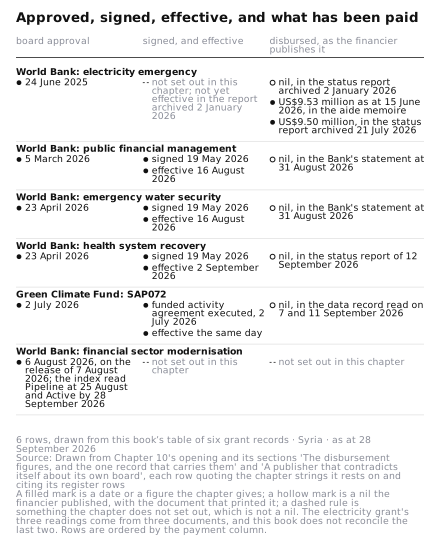
Read again on 15 October 2026
A figure taken from a portal is a claim about the day it was read, so I read the same records again on 15 October 2026, after the book's closing date.
The World Bank's monthly statement of its grants to Syria, for the period ending 30 September 2026, shows the electricity grant at US$9,644,144 disbursed, against US$9,534,144 a month earlier. That is about US$110,000 more, on my arithmetic, and the latest disbursement is dated 21 September. The public financial management, water and health grants show nothing disbursed. The same statement lists two further grants approved after my register's count: US$2 million, signed and effective on 30 August, and US$3.25 million, approved on 14 September. Neither had disbursed, and neither belongs in the dot.
And when I read the Green Climate Fund's projects database on 15 October 2026, it recorded a first disbursement on the Fund's grant: US$6,003,501, effective 14 October 2026, to ACTED, the accredited entity. That is the first money on that record. The approved funding proposal names two executing entities, ACTED's Syrian branch and the Ministry of Local Administration and Environment. How much of this payment reaches either, the disbursement record does not say.
Built around the banks
The design of the electricity grant, the one that first disbursed in April, matters more than its size. The World Bank's appraisal of 9 June 2025 says that "Disbursements for key project activities representing US$144 million out of the total US$146 million in Project financing will be made through direct payments". On that design the financier pays suppliers and consultants itself, and the money is not meant to pass through a Syrian bank. The disbursement letter of 25 November 2025 put that beyond argument. Its designated account block, including the name of the financial institution, reads Not Applicable throughout.
And the first money did not go to a Syrian institution or into a Syrian account. The aide memoire of the June 2026 mission records that "The full US$9.53 million advance was transferred to UNMAS on April 1, 2026", the United Nations Mine Action Service, under an agreement between the implementing agency and that service for demining and the removal of explosive remnants of war from project sites and access routes. As of 15 June 2026 the service had used US$128,841 of it. Bank accounts in Syria for the project do exist, at AlBaraka Commercial Bank, and they are not a designated account either. They are the implementing agency's own, which the aide memoire says the agency will use to pay local costs from its own funds and then seek reimbursement. On that design the agency's money goes out first and the financier repays it, and as at 15 June 2026 that design had not yet run.
None of that is a criticism; it is the design. But on the Bank's own monthly statements the disbursed total did not move from 1 April until at least the end of August 2026, so for five months the whole of the money the one disbursing grant had paid out was an advance to a United Nations service clearing mines.
Announced, booked, spent
The two Development Programme energy grants show three different numbers for the same two transactions, from one publisher, and they show why the words have to be kept apart.
The releases are specific. On 10 February 2026 Japan and the Programme launched a US$12.4 million project at the Jandar power plant. On 11 February 2026 the Programme signed a US$10.7 million agreement with Italy and Norway for the Deir Ali extension, made up of five million euro from Italy, described as a first phase, and US$5.1 million from Norway. The Programme also publishes its own project accounts, and they carry different numbers. All figures are United States dollars.
| Project | Announced | Booked budget | Spent, 28 September 2026 | Spent, 15 October 2026 |
|---|---|---|---|---|
| Jandar, funded by Japan | 12,400,000 | 12,126,270 | 753,217 | 790,838 |
| Deir Ali, funded by Italy and Norway | 10,700,000 | 6,217,420 | 675,707 | 794,809 |
| Both | 23,100,000 | 18,343,690 | 1,428,924 | 1,585,647 |
Jandar's booked budget is 2.2 per cent below its headline, on my arithmetic, the kind of gap a currency conversion or a fee line explains, since the grant is in yen. Deir Ali's is 42 per cent below, on my arithmetic, and no exchange rate explains it: five million euro plus US$5.1 million does not come to US$6.22 million at any rate either currency has traded at. At least one contribution is not fully booked, which fits the release calling Italy's a first phase, and it means the US$10.7 million headline describes an intention rather than a budget. Spending at 15 October 2026 was 8.6 per cent of the booked budget and 6.9 per cent of the announced total, on my arithmetic.
None of this alleges that money is missing. Budgets are booked in tranches as donors transfer them, and spending lags works by the length of a procurement cycle. A reader given the headline learns what three governments intended. A reader given the budget learns what the implementing agency has to spend. A reader given the expenditure learns what has been spent. Those are three facts about the same two projects, one publisher discloses all three, and anyone who wants to know whether money moved has to say which of the three they are quoting. The Programme's spending is also not a transfer to a Syrian entity: it is the implementer's own spend on works and equipment, and whether it reaches a Syrian counterparty depends on who is contracted, which the accounts do not say.
The first proof point
So the dot is real, it is small, and it is mostly not yet money in motion. The book's Chapter 10 takes each source of capital in turn and asks what stands between it and a transaction. Chapter 11 asks what should come first, and its answer, offered as an assessment and open to the specialist review it has not had, is not a bond. It is a completed, independently appraised, publicly reported project financed through the multilateral route that is already open, with its procurement published and its structural sign-off named. That is the record any later issuance would be priced against. Among the forty transactions in my register at 28 September 2026, none had got beyond first disbursement, so my register held no such track record yet for anything to be priced against.
What the Record Shows, part 5 of 13. This article is drawn from my new book, Financing Syria's Reconstruction: The Numbers That Do Not Hold, published in November 2026 in English in hardcover, in paperback and on Kindle, and in Arabic on Kindle. The book's public evidence register holds the records the book counts, and the dates on which I read them. Part 6 turns to the account at the Federal Reserve Bank of New York that the Central Bank of Syria announced in February 2026 it had reopened, and to what its own governor said would happen if the money in it were used for commercial activity.
The book is Financing Syria's Reconstruction; passages drawn from it are from its approved chapters.
Related posts
Seven Hundred and Fifty Times
In March 2025 the International Renewable Energy Agency put Syria's off-grid solar at 2 megawatts for 2024. A year later it put the same year at 1,500. Neither edition says why. Around that revision sit a rooftop build-out that, as far as I can find, Syrians mostly paid for themselves, and a state credit scheme that on my arithmetic reached at most one or two per cent of it.
Twenty-Three Point Six Billion Dollars, Before the Report
Global Financial Integrity's estimate of Syria's illicit financial outflows over 2000 to 2009 circulates as US$23.6 billion, often with a loss per Syrian attached. The report it is credited to gives two figures rather than one, divides by nobody, and was not yet published on the day the number first appeared.
How a Cost of War Became a US$923 Billion Rebuild
An International Labour Organization factsheet says rebuilding Syria could cost "USD250 to USD 900+ billion". Follow its footnote and the upper figure turns out to be something else: the UN Development Programme's estimate of what the war cost, most of it output that was never produced. Here is the chain, link by link, and what the one number from a full assessment actually measures.