Seven Hundred and Fifty Times
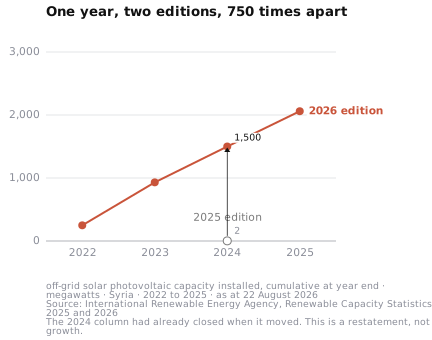
In March 2025 the International Renewable Energy Agency put Syria's off-grid solar at 2 megawatts for 2024. A year later it put the same year at 1,500. Neither edition says why. Around that revision sit a rooftop build-out that, as far as I can find, Syrians mostly paid for themselves, and a state credit scheme that on my arithmetic reached at most one or two per cent of it.
A standalone article drawing on my forthcoming book Financing Syria's Reconstruction. Part 4 of 13 in the series What the Record Shows. Every figure carries its publisher, unit and date; every calculation that is mine says so.
In March 2025 the International Renewable Energy Agency published its annual capacity statistics and recorded Syria as having 2 megawatts of off-grid solar photovoltaic capacity installed at the end of 2024. Total Syrian solar capacity, on and off the grid together, it put at 60 megawatts.
A year later the same agency published the same series for the same year and recorded 1,500 megawatts off-grid, and 1,606 megawatts in total. The off-grid figure for one year became seven hundred and fifty times as large, on my division, between two editions of the same table.
In the last part of this series a number travelled with one end of its range left behind. This one did not need to travel. It was restated at source, by its own publisher, a year after the fact, and when I last checked, on 15 October 2026, the old total was still on the publisher's website.
A closed year that moved
The restated year had already closed. Whatever Syrians built during 2025 cannot change what the 2024 column records, and the 2024 column is what moved, along with 2022 and 2023. The agency's own Syria country profile, which states that it was last updated on 22 September 2025, still carried the 60 when I fetched it again on 15 October 2026. A reader who searched for Syrian solar capacity in the ordinary way, and stopped at the first authoritative-looking document, would have found a figure the publisher has since multiplied by about twenty-seven, on my division.
The editions do say something about where their numbers came from. In the 2025 edition the off-grid table gives Syria 2 megawatts in each of 2022, 2023 and 2024, flagged as an official figure for 2022 and as the agency's own estimate for the two years after. In the 2026 edition every Syrian off-grid value carries the flag for a figure obtained from an official source. So the earlier 2 megawatts was not an orphan. It was an official figure for 2022 that the agency carried forward as its own estimate, and the new series is official throughout.
What neither edition says is why the series changed. By 11 September 2026 I had read the tables, notes and front matter of both editions, the four highlights notes that came with them and with the agency's July statistical yearbooks of 2025 and 2026, its statistical notes and methodology page, and its energy taxonomy. None of them explains the change. What the agency does not publish is what passed between it and the Syrian side, and that is where the explanation, if there is one, sits.
Eleven to one
On the current edition, off-grid solar in Syria reached 2,060 megawatts by 2025, from 249 megawatts in 2022, 931 in 2023 and 1,500 in 2024. Grid-connected solar stood at 189 megawatts, which is the difference between the edition's total solar table and its off-grid table, 2,249 less 2,060, on my subtraction. The agency's online data portal, when I read it on 11 September 2026, carried the grid-connected figure as a series of its own, 58 megawatts in 2022, 91 in 2023, 106 in 2024 and 189 in 2025, and in every year it is exactly the difference between the two printed tables. On my division that is roughly eleven to one in favour of capacity that is not connected to the grid.
That ratio is a statement about the grid as much as about panels. The World Bank's appraisal of its electricity emergency project, dated 9 June 2025, says the available fuel supply "is barely sufficient to run the system at 1800 MW; providing two to four hours of electricity per day, on average". That is a national average of grid supply, not a measure of household access to electricity, which is a different quantity in a country where so much capacity sits on roofs.
What a household paid
The household price comes from a signed opinion column by Robin Mills, chief executive of Qamar Energy, in The National of 6 July 2026. "A basic household set-up of 1.5 to 3 kilowatts costs from $2,500 to $4,500. This is still expensive in a country with per-person income estimated at about $800." The column also says that a quarter of Syrian households have some kind of solar power.
The system size can be set against the capacity only on one assumption that has to be stated, because no source I have opened measures it: that the great majority of the off-grid stock is household systems of that size, rather than the larger arrays that run irrigation pumps and workshops. On that assumption 2,060 megawatts implies somewhere between about 687,000 and 1,373,000 installations, on my arithmetic. To the extent the assumption is wrong, the count is lower and the systems are bigger.
Two further clauses are easy to read into this story, and it matters that the column does not carry them: that Syrians bought all of it with no formal financing available to them, and that they bought it in a market flooded with counterfeit equipment. I read the column in full and it contains neither. I searched it for twelve terms, finance, credit, loan, instalment, counterfeit, fake, substandard, quality, certification, warranty, standard and inspection, and it carries none of them.
The second clause has support, but for a narrower area than the clause itself covers. A report published by CA-SYR on solar energy in north-eastern Syria describes "counterfeit and low-quality products" flooding the market, and says that "Formal financial support for solar adoption is largely absent." It describes the north-east, not Syria as a whole. It also carries a finding that the column does not mention: that solar-powered irrigation pumps have contributed to the depletion of the water table.
The first clause is false as a statement about Syria in 2023 and 2024, and what falsifies it is the more interesting story.
The credit scheme that existed
Law No. 23 of 19 October 2021 established a fund to support the use of renewable energies and raise energy efficiency, and made it a lender. Its Article 12 finances the fund from, among other things, one per cent of the value of the electricity consumed by all subscribers. On the face of the law, every electricity bill in Syria was paying for it.
Lending began in early 2023 through the Commercial Bank of Syria and the Popular Credit Bank. On figures that an Al-Jumhuriya investigation, published on 14 March 2025, obtained from the fund's employees, the fund made about 16,000 loans over a year and a half, across all its target groups, which included solar water heaters as well as household photovoltaic systems. None of those figures is an audited count. On 19 December 2024, eleven days after the fall of the previous government, the caretaker Minister of Electricity halted the platform for loan applications and stopped referrals to the lending banks, according to the investigation, which reproduces the decision. I have not read the decision itself.
Set 16,000 loans against somewhere between about 687,000 and 1,373,000 systems, and the formal mechanism financed on the order of one or two per cent of the installed base at the end of 2025, on my arithmetic and on the assumption of roughly one system per loan. That is an upper bound. The true household share is lower.
So the question is not why there was no credit. It is why a national credit scheme, offered interest-free by the state and, on the face of the law, paid for out of every electricity bill, reached so few of the households that were installing anyway. The answer is in its terms. A manager of an engineering office accredited by the fund put the eligibility plainly to the investigation: "Not just anyone could apply for the loan. The applicant had to be a government employee or provide substantial financial guarantees. Even then, securing two guarantors was mandatory." Under the fund's mechanism, borrowers did not receive the money directly; accredited companies did the installation and were paid by the bank after inspection. And the loan ceiling and the approved-supplier list together decided what a household could buy.
That last term rearranges an account in which poor equipment is the problem and credit its missing solution. Engineers accredited by the fund itself describe the result. "At first, we used to receive photovoltaic equipment of acceptable quality," one told the investigation, until some importers began travelling to China to request modifications that lowered quality to cut costs and raise margins: "Unfortunately, low-quality solar equipment was included in subsidized loan projects." Of another, the investigation reports his view that many beneficiaries were "forced to choose mediocre or low-quality systems due to the restrictions imposed on loan values". In the subsidised channel, the trade in low-quality equipment and the credit scheme were the same thing.
The scheme's last months narrowed it further. On 12 November 2024 the fund's director signed an agreement under which the companies it accredited had to buy locally manufactured panels. One accredited contractor put the price effect at 2.15 million old Syrian pounds a panel through the fund, against 1.6 million in the open market.
That makes Syria's household solar credit facility not a proposal but a completed experiment with a published result. A new scheme that does not change those terms is a proposal to run it again.
What the stock becomes
Two gigawatts of off-grid capacity, most of it on roofs if the household-systems assumption above holds and none of it connected to a grid that the World Bank, in June 2025, put at two to four hours a day on average, leaves the question Chapter 8 of the book ends on: whether that stock remains between about 687,000 and 1,373,000 private coping mechanisms or becomes a national asset that can be seen, dispatched and borrowed against. The chapter names the document that would have to exist, a least-cost plan that answers whether the next dollar of Syrian electricity investment should go into the grid or into the roofs, and sets out what a replacement for the credit scheme would have to pass to be financeable, rather than merely announced.
What the Record Shows, part 4 of 13. This article is drawn from my new book, Financing Syria's Reconstruction: The Numbers That Do Not Hold, which comes out in November 2026, in English in paperback and on Kindle and in Arabic on Kindle. Part 5, in the book's launch week, sets the two numbers on its cover side by side: the bill, and the commitments against it that my register held on 10 August 2026. The book's public evidence register is already online. If you want to know when the book is out, the book page has a waiting list: one email, on the day it goes on sale.
The forthcoming book is Financing Syria's Reconstruction; passages drawn from it are from its current approved chapters and may change before publication.
Related posts
Twenty-Three Point Six Billion Dollars, Before the Report
Global Financial Integrity's estimate of Syria's illicit financial outflows over 2000 to 2009 circulates as US$23.6 billion, often with a loss per Syrian attached. The report it is credited to gives two figures rather than one, divides by nobody, and was not yet published on the day the number first appeared.
How a Cost of War Became a US$923 Billion Rebuild
An International Labour Organization factsheet says rebuilding Syria could cost "USD250 to USD 900+ billion". Follow its footnote and the upper figure turns out to be something else: the UN Development Programme's estimate of what the war cost, most of it output that was never produced. Here is the chain, link by link, and what the one number from a full assessment actually measures.
If Twenty-Five Billion Dollars Arrived Next Month
A hypothetical: the Syrian government receives US$25 billion next month. Could its banks hold the money, its offices turn it into projects, its laws carry the contracts and its people build them, and how long would it take? On the record I keep, the answer is not yet, not at that scale and not quickly, with exceptions the record names: multilateral grants, budget support and operators' own capital.