If Twenty-Five Billion Dollars Arrived Next Month
A hypothetical: the Syrian government receives US$25 billion next month. Could it decide where the money goes, prepare the projects, buy, pay, check and count the people who would do the work? The record my book opened answers most of that, and the answer turns less on the money than on what would receive it.
A companion to the series What the Record Shows, drawing on my new book Financing Syria's Reconstruction. Every figure carries its publisher, unit and date; every calculation that is mine says so.
Take a hypothetical: the Syrian government receives US$25 billion next month. It is not an offer and not a forecast; it is a way of asking what the money would meet. If the money came, could the state decide where it goes, turn it into projects, pay for them and show what they produced?
The finance ministry puts the state's spending budget for 2026 at US$10,516 million. The hypothetical is about 2.4 times that, on my division (25,000 ÷ 10,516). The same ministry's report on the first half of 2026 gives the year's allocation for investment spending, the line for establishing and developing government projects and assets, a reserve included, as US$2,888 million; the hypothetical is about 8.7 times it (25,000 ÷ 2,888, my division). And institutional commitments to Syrian reconstruction, as my register held them at 10 August 2026, come to US$539.1 million across eight transactions; the hypothetical is about 46 times that (25,000 ÷ 539.1, my division). The hypothetical is one receipt, the budget lines are a year's and the commitments a total at one date, so these ratios measure size, not pace.
A sum of that order already exists on paper. The anti-corruption resource centre U4 reported on 6 March 2026 that "the content and selection criteria of the US$27 billion in investment agreements signed by the new government have not been published". U4 calls them signed. My book follows every transaction through eleven stages, from announcement to audited outcome, set out in the figure below. A signed agreement is the fourth. Money arriving is the seventh, first disbursement. Between them stand conditions precedent and financial close, and the hypothetical steps over both.
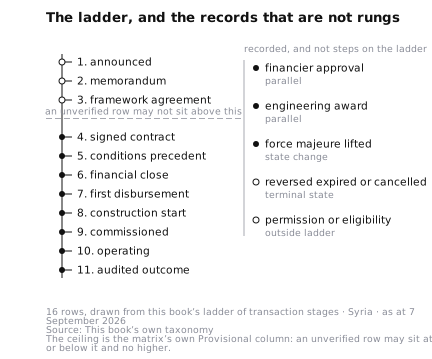
The ladder, and the records that are not rungs: eleven stages from announcement to audited outcome, and five records that sit beside the ladder rather than on it (the book's figure). The figure labels the fourth stage "signed contract"; the text calls it a signed agreement.
The complaint, and the other half of it
On 25 September 2026 Alhurra published, on its YouTube channel, an interview with Raed al-Saleh, Syria's Minister of Emergency and Disaster Management, which it describes as a special interview from the United Nations. In it he said: «مثل ما المجتمع الدولي خذل الشعب السوري على مدار 14 سنة الماضية. اليوم المجتمع الدولي عم يخذل الشعب السوري مرة ثانية», "just as the international community let the Syrian people down over the past 14 years, today the international community is letting the Syrian people down again" (my translation). His grievance is that no conference for Syria's reconstruction has been held and the money has not been raised. He adds that Syria does not need all of the financing, and that it is asking not for aid but for partnership. In the two clips from the interview on Alhurra's YouTube channel, he does not say that pledged money failed to arrive.
He also put a figure on the need: "more than 300 billion", with no unit, on what "the estimates say", and with no source named. His measure is wider than the World Bank's US$216 billion, its conservative best estimate, inside a range of US$140 billion to US$345 billion, of the cost of rebuilding damaged physical assets: reconstruction, as he describes it, includes rebuilding the economy and restarting production.
In a second clip he gave the balance himself: «كل الدول حقيقةً عندها حماس للعمل بسوريا ولكن هي موضوع مرتبط بأنه قدّ ما نحن فينا نمشي خطوات عملية», "all states truly have enthusiasm to work in Syria, but it depends on how far we can take practical steps" (my translation).
On 12 October 2026 Ibrahim Olabi, Syria's Permanent Representative to the United Nations, told the Security Council, in the UN's English, that Syria was no longer asking for political support, "for you have given that support. What we are asking from you today is to turn this support into a just partnership". On 15 September 2026, ten days before the interview was published, President Ahmad al-Sharaa said of Syria's challenges, as the state news agency reported him, «لا يجب اتباع سياسة الشكوى أو إطلاق الوعود الحالمة»: neither a policy of complaint nor dreamy promises should be followed (my translation). And at the Global Security Forum in Doha, as SANA reported him on 20 October 2026, after my book's closing date, al-Saleh asked for support «يمكن التخطيط على أساسه», that can be planned on (my translation).
The ratio between what has been committed and what the World Bank and the Green Climate Fund have published as drawn is, as at 18 October 2026, "about thirty-four to one on my division. That is not a scandal and it is not evidence of failure." Grants approved in April and August 2026 "could not have disbursed much by October 2026". The United Nations Development Programme's two energy grants, at Jandar and Deir Ali, show three numbers in its releases and project accounts, in US dollars:
| Announced | Booked | Spent at 18 October 2026 | |
|---|---|---|---|
| Two grants | 23,100,000 | 18,343,690 | 1,585,647 |
Of 54 economic memoranda and agreements whose signature the government announced in 2026 up to 28 July, The Syria Report recorded that day, in a standfirst that is all I have read of it, that seventeen had clearly entered the implementation phase: the outlet's phrase, which maps onto no single stage of the ladder. "Seventeen of fifty-four is not a scandal", in my book's words.
Both can be true at once: the minister's grievance that, as at 25 September 2026, no conference for Syria's reconstruction had been held, and the record my book keeps, in which the gap between committed and drawn is, in its words, "a fact about the age of the portfolio and about what institutions choose to publish".
Is there a plan?
There is a document: the Statement of Recovery Priorities for International Cooperation, issued by the Ministry of Foreign Affairs and Expatriates in March 2026 and launched in Damascus on 2 April. The text I have read, whole, is a nineteen-page English copy under the ministry's name, posted on LinkedIn on 11 March 2026; I have not been able to establish that it is the text launched on 2 April.
That text sets four priorities: critical infrastructure, basic services, social and economic resilience, and core systems and public administration. It says they "follow a sequential logic, beginning with rehabilitating critical infrastructure" (p.8). It names one coordinating body for all international assistance (p.14), but costs none of the four priorities, sets the government no timetable and names no owner for any of them; its one stated period, "a 12–24 month timeframe" for tangible outputs, is a requirement on partners' plans (p.18). It says of itself that "it does not yet rise to the level of a sectoral investment programme" (p.7). And it states this article's argument itself: "recovery is as much a challenge of institutional capacity for planning, implementation, and accountability as of the availability of resources" (p.8).
The World Bank's assessment "does not provide detailed disaggregation by sectors or individual asset types", and its figure, as my book puts it, "carries no statement of how much Syria could absorb in a year even if the money existed".
So where would the money go? I do not answer that with amounts. The book publishes no phased total, because the national figure has no time dimension and only a split across three asset categories, and it does not recommend "a sequence of transactions". It offers an order, and the functions the money would pass through.
Could the state spend it?
The finance ministry's report on the first half of 2026 says «وبلغ تنفيذ النفقات الاستثمارية نحو 35% من مخصصاتها السنوية»: investment spending reached about 35 per cent of its annual allocation, US$1,021 million of US$2,888 million (pp.16 and 18). The ministry expects spending to rise in the second half "with the continuing full effect of the salary increase and the progress in implementing investment projects" (my translation). Those are six months, in dollars with no exchange rate printed, and not said to be audited. Its summary of 2025, under a heading on sound financial management, lists among that year's spending factors «تأجيل الانفاق الاستثماري لحين دراسة الجدوى الاقتصادية والاجتماعية لها», postponing investment spending until its economic and social feasibility has been studied (p.4, my translation).
Five functions stand between a receipt and a project.
Preparing projects. My book reports: "Searching what I hold, on 27 August 2026, under readiness, preparatory support, project preparation, upstream support, country programming and public-private partnership, I found nothing describing a Syrian body that produces what an infrastructure financier reads: feasibility, safeguards, land resolution and financial models, at project scale, as its job. That is a statement about the documents I hold and have searched, not about the world." The consequence, in the book's words: "announcements arrive faster than prepared projects, so the state signs memoranda because memoranda are what it can produce."
Deciding which projects go ahead. Public investment management is "a single gateway through which projects pass, in a stated order, with a decision recorded at each gate". My book names it, and project preparation, as functions rather than bodies, and says of both: "Neither requires a new law to begin."
Buying. The contents and selection criteria of the US$27 billion were unpublished on U4's account of 6 March 2026. My book shows the state can publish; what is missing, in its words, is "not machinery but a duty to publish that travels with the money rather than with the ministry".
Paying. Correspondent banking is the standing example of a gate the state does not control: "a foreign bank's compliance committee, which no ministry instructs and no donor can pay to say yes". The United States rescinded Syria's designation as a State Sponsor of Terrorism on 24 August 2026. Syria is on the Financial Action Task Force's increased monitoring list of 19 June 2026; the Task Force's next plenary meets on 28 to 30 October 2026, on its notice of 20 October 2026.
Checking. The head of the Central Organization for Financial Control, in an interview published on 9 July 2026, put the amounts discovered in 2025 at about US$3.41 billion, besides sums in pounds and other currencies, and the dollars recovered at about US$329,000; the organisation's own report for 2025 gives the same totals rounded. Converted to dollars at the outlet's rates and added across currencies, recovery comes to about US$13.3 million against about US$3.65 billion discovered, which my book puts at "roughly a third of one per cent"; on the dollar line alone, the organisation's own report puts recovery at about 0.01 per cent.
The people
On 31 January 2025 Reuters reported the caretaker finance minister, citing a preliminary review, as saying that only 900,000 of 1.3 million people on the government payroll actually came to work, and that this meant 400,000 ghost names. That is a minister's account of a review, not a count. In my book's words, "A payroll is an accounting object and a household is not, so a state can compute the saving from a dismissal and cannot compute its cost."
For teachers, my book prints the UNESCO Institute for Statistics' series, as the World Bank's indicator service gives it: trained teachers were 88.4 per cent of primary teachers in 2002 and 38.3 per cent in 2024. Whether 2002 and 2024 count the same population of teachers "is a question I put and do not answer".
Professionals coming home meet a queue. The Minister of Higher Education has set out the procedure for degree equivalence in four stages; in what my book searched of the ministry's publications by 13 September 2026, no time for any stage is printed, and I cannot say that no such period exists in Syrian law. On 10 August 2026 the minister put the certificates in hand for professional purposes at about four thousand. My book asks for a published processing time, with the backlog beside it, and says of that and its other indicators: "None of these requires new technology or a donor programme."
The towers
Marota City is the most visible product of Legislative Decree No. 66 of 2012, built on the Mezzeh-Basateen al-Razi area of Damascus, whose residents were evicted in 2017. Of a committee the Secretary-General of the Presidency formed on 4 December 2025 to review the decree's application, Damascus Governorate wrote on 5 May 2026 that it had not been destined to succeed or to finish, and it announced a package of measures. On its own account of 26 May it had paid raised rent allowances to about 1,600 of the 3,000 entitled people its plan covered, and in July its channel was still showing the towers of the alternative housing under construction. The owners' side rejected the package at once, and on 16 August 2026 Syria TV reported residents' representatives saying they had still not agreed to it.
The project has gone on, and its two latest instruments in my book's record are memoranda, the second stage of the ladder. On 26 June 2026 the governorate signed a memorandum to begin the procedures for completing Marota City's infrastructure, and on 14 September 2026 Cham Bank announced a memorandum to offer finance for buying units in it.
In my book's words, no project on affected land "can demonstrate site control, and site control is a first-hour condition of project finance, not a closing formality".
What change looks like
The United Nations' country analysis of 31 March 2026 counsels that recovery investments be "sequenced around visible improvements in people's daily lives". My book's version is narrower: "Sequence around improvements that are visible and checkable, publish the checkable part".
The Statement's English copy places the clearance of mines inside what it calls a "necessary procedural enabler for infrastructure rehabilitation". Between 8 December 2024 and 1 July 2026 the Mine Action Area of Responsibility recorded 2,343 casualties, 828 of them killed, in its Situation Update No. 8, published on 23 July 2026. The word civilian, in its previous update, is not in this one, and neither document says the population counted changed.
My book proposes an order, for the specialist scrutiny it has not had: "retrenchment and tariff reform come after a transfer mechanism is demonstrably operating".
My assessment, "offered as an assessment and open to the specialist review it has not had", is that the first proof point should be "a completed, independently appraised, publicly reported project financed through the multilateral route that is already open", because "a small verifiable transaction is worth more than a large announced one". Some things the hypothetical would not buy at any price: "A returning postgraduate cohort requires the years of the degree."
What the money would find
The hypothetical US$25 billion would find a statement of priorities that is not yet an investment programme; no body, in the documents I searched on 27 August 2026, whose job is to prepare projects to the standard a financier reads; signed agreements whose content U4 reported unpublished; and a payment channel decided abroad. My book's recommendations that survive the evidence "need no capital, no new legislation, no foreign consent and no specialist opinion", and the last part of What the Record Shows will set them out.
The gap between what is announced and what is delivered is not evidence of bad faith; in my book's words, it "is evidence that the stage a transaction has reached is a fact about the transaction, not about the enthusiasm of its parties. Announcement and delivery are different activities, and Syria is currently much better at the first."
A companion to What the Record Shows. This article is drawn from my new book, Financing Syria's Reconstruction: The Numbers That Do Not Hold, which comes out in November 2026, in English in paperback and on Kindle and in Arabic on Kindle. The book's public evidence register holds the records the book counts, and the dates on which I read them. The series' parts are collected on its page.
The book is Financing Syria's Reconstruction; passages drawn from it are from its approved chapters.
Related posts
I Corrected My Own Book
My earlier book on Syria went on sale the week the World Bank published its estimate of what rebuilding the country would cost. My book said US$250 billion to US$400 billion. The Bank said US$216 billion. Here is what my range was missing, what else did not survive being checked, and why the corrections became a second book.
The Confidence Tax: Why Reviving Syria's Ottoman Endowment Records Will Cost More Than It Recovers
An analysis of the Syrian Ministry of Endowments' plan to reclaim historic waqf properties using Ottoman archives. Explore why reopening century-old title deeds acts as a tax on property confidence, undermining post-conflict reconstruction and urban recovery.
Utility-Led Distributed Energy Storage
An Energy-as-a-Service Framework for Post-Conflict Syria Executive Summary This document presents a strategic proposal for utility-led distributed energy storage (DES) in post-conflict Syria, structured as an Energy-as-a-Service (EaaS) framework. It draws on international evidence from pioneering programmes in the United States, Australia, Lebanon, and other markets, extracting both positive models and cautionary lessons to inform