How a Cost of War Became a US$923 Billion Rebuild
An International Labour Organization factsheet says rebuilding Syria could cost "USD250 to USD 900+ billion". Follow its footnote and the upper figure turns out to be something else: the UN Development Programme's estimate of what the war cost, most of it output that was never produced. Here is the chain, link by link, and what the one number from a full assessment actually measures.
A standalone article drawing on my forthcoming book Financing Syria's Reconstruction. Part 2 of 13 in the series What the Record Shows. Every figure carries its publisher, unit and date; every calculation that is mine says so.
In October 2025 the International Labour Organization published a five-page factsheet on what refugee returns are doing to labour markets in Syria and in the countries that host them. In a paragraph of context near the top it says: "Reconstruction needs could range from USD250 to USD 900+ billion."
In the same month the World Bank's assessment put the cost of rebuilding at US$216 billion. So one institution of the United Nations system is saying the bill might be four times, on my division, what another institution of the same system says it is.
In the first article of this series I said the ceiling of this range is not a cost of rebuilding at all. This is how it became one. It takes four documents, published between January and October 2025.
The footnote
The factsheet's sentence carries a footnote, number six. It is a bare web address, with no author, title or date, and it leads to a one-page briefing the European Parliamentary Research Service published in March 2025 for Members of the European Parliament. That briefing contains the sentence the whole chain rests on: "With a GDP less than half of its 2011 value, extensively damaged critical infrastructure and 90 % of Syrians living in poverty, the cost of rebuilding the country could range from US$250 billion to US$923 billion."
The briefing has no footnotes. What it has is embedded links, five of them on that sentence, and they do not all point to the same place. Three go to the UN Development Programme's publications page for its socio-economic assessment of the conflict: two on the clause about gross domestic product, and one on the words "US$250 billion to US$923 billion". A fourth, on the word "cost", goes to a commentary the Atlantic Council published on 3 January 2025, which says that "the estimated cost of rebuilding the country ranges between $250 billion and $400 billion" and gives no source for it. The fifth, on "critical infrastructure", goes to a republished analysis that carries no monetary figure at all.
So the range was assembled, not quoted. Its floor comes from a think-tank commentary and its ceiling from an assessment of something else, and nothing I have opened behind the links publishes US$250 billion to US$923 billion as a range: not the Development Programme's publications page, in the copy the Internet Archive took on 23 February 2025, not the report it offers, in either file of it I hold, not the commentary and not the republished analysis, all read between August and October 2026.
What the US$923 billion is
The Development Programme's assessment was published on 19 February 2025, the date its publications page carries, the month before the briefing. It puts what it calls "the financial and economic cost" of the conflict at US$923 billion to the end of 2024, and it sets out how it got there, in a methodological annex.
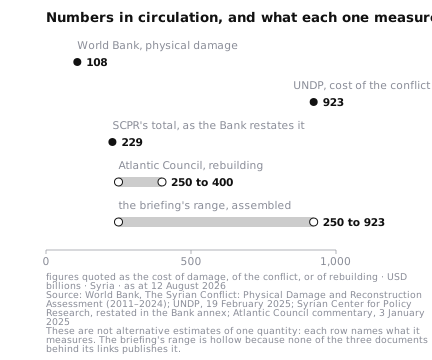
Most of it, US$799.4 billion, is foregone output: the cumulative gap between Syria's actual real gross domestic product and a projection in which the economy grew at a steady five per cent a year without the war, at constant 2010 prices. The rest, US$123.3 billion, is destroyed physical capital, and the report does not give it a price basis. It is assembled from three pieces: a 2020 estimate by the UN Economic and Social Commission for Western Asia (ESCWA) of US$117.7 billion for 2011 to 2018, US$5.1 billion of damage from the February 2023 earthquake, and US$0.5 billion from localised battles estimated by the study team.
That is a coherent and useful quantity. It answers a real question, which is what the war cost Syria, and it includes a modelled counterfactual of output that was never produced. It also adds a flow of lost output to a stock of lost capital, which is why the two are better given separately. It is not the cost of rebuilding. No reconstruction budget, however large, buys back a decade of output that never happened. You cannot build the output of 2016.
The figure below is the book's own. It sets side by side the numbers quoted about Syria as though they answered one question, and names what each one measures. Two of them are not in the briefing's chain. The World Bank's US$108 billion of physical damage was published after it. The other is the Syrian Center for Policy Research's estimate of total economic losses from 2011 to the end of 2015, which the World Bank's annex restates at US$229 billion in December 2024 values. That is a loss too, not a bill.
A splice, a relabelling, a rounding
The Development Programme's report itself calls US$923 billion "the financial and economic cost" of the conflict, and nowhere calls it a cost of rebuilding. Its own introduction had already described "the enormous reconstruction challenge" as one "this report provides an updated estimate for", "running into hundreds of billions of dollars", without giving the figure, and later on the page that defines it the report says the estimates, its own among them, "illustrate the monumental challenge of reconstruction ahead". Its publications page, the page the briefing links to, carries the introduction's sentence and not the definition, in the copy the Internet Archive took on 23 February 2025. The Research Service's briefing took the last step: it put the figure to those words, joined it to a floor from somewhere else and printed the result as a single range. Then the factsheet rounded US$923 billion to "900+", so the number changed shape as well as meaning.
It is worth naming the mechanism precisely, because the obvious names are wrong. It is not fabrication and it is not fraud. Each step is small. It is scope loss in transmission: a number travels better than the sentence that defines it, and the sentence is the first thing dropped. What is notable here is how short the chain is and how identifiable each step. A splice, a relabelling, a rounding, and a figure four times the Bank's estimate, on the division above, is in circulation carrying the authority of a United Nations agency, in a document written for people who allocate money.
The consequence is not abstract. A conflict-cost figure is an argument about what was lost and who is answerable for losing it. A reconstruction figure is an argument about what to spend now. Put the first in place of the second and the ask is inflated, and an inflated ask is not a harmless exaggeration: it makes a credible programme look unfundable and invites the answer that the number is so large there is no point beginning. The damage done by an unsupported figure is rarely that somebody acts on it. It is that somebody declines to act at all, because a number they cannot check has made the whole file look unreliable.
What looks like corroboration and is not
The two assessments also seem, at first sight, to confirm each other. The Development Programme's destroyed capital is US$123.3 billion. The World Bank's direct physical damage is US$108 billion. Two bodies, eight months apart, within about 14 per cent of each other, on my arithmetic.
It is not independent confirmation. The Development Programme did not measure its figure; it added up two other bodies' estimates and half a billion of its own, and the largest piece is ESCWA's estimate for 2011 to 2018. Its earthquake piece is a World Bank estimate, so the apparent corroboration contains the corroborator, and it is a median: the Bank's own rapid assessment gave US$5.1 billion inside a range of US$2.7 billion to US$7.9 billion, and the range was dropped when the median travelled into the sum. The Bank, for its part, says it calibrated its damage estimates against previous work, ESCWA's and the Development Programme's among them.
To the Bank's credit, it did the work the comparison needs, in an annex. It restates the earlier national estimates to December 2024 values, and on that basis the Development Programme's figure becomes US$117 billion and ESCWA's US$112 billion, against its own US$108 billion. The convergence is real once the adjustment is made. What it is not is independent, and a reader told that the United Nations and the World Bank agree has been told something true about the arithmetic and misleading about the evidence.
What the US$216 billion is
So here is the number that came from a full assessment of the whole conflict period, with the sentences that belong to it.
It is the cost of rebuilding damaged buildings and infrastructure to current standards, in December 2024 dollars, at unit costs the Bank puts at 2.1 times pre-conflict levels for housing and up to 3.3 times for infrastructure. It is "a conservative best estimate" inside a range the executive summary gives as US$140 billion to US$345 billion and the detailed findings as US$141 billion to US$343 billion. It is not the midpoint of either, which for the first would be US$242.5 billion, on my arithmetic.
It is a net figure. The Bank subtracts its own estimate of the share already rebuilt by 31 December 2024 in each governorate, 17.5 per cent in Aleppo, 27.5 per cent in Tartous and 37.5 per cent in Raqqa among them, so the US$216 billion is a residual as at a date and it decays as reconstruction proceeds. And the Bank says it is about ten times Syria's 2024 gross domestic product, which it puts at US$21.4 billion in current dollars. That sizes the problem. It sets a total with no time attached beside one year's output, and it says nothing about what a year of Syrian output could fund.
It also leaves things out, and says so: economic losses, cultural heritage and the cost of restoring services, and it does not fully capture minor damage to homes or lost contents. The Bank's own conclusion is that "the actual damage and reconstruction costs may be higher". The failure is not in the document. It is in what happens to it afterwards, when the range is dropped, the price basis is dropped, the definition is dropped and the netting is dropped, and what remains is a single number separated from every sentence that made it usable.
What the bill does not tell you
Even read with all its sentences, the US$216 billion is a size and not a plan. It gives no cost for any sector below three broad categories, so the cost of rebuilding Syria's hospitals is not in it: hospitals sit inside "non-residential" with ministries, shops and schools. It gives no split between the part that must be paid in foreign currency and the part paid in Syrian pounds, no split between public and private ownership, and no annual profile. And the Bank names "build back better approaches" among the drivers that push its unit prices up and leave its estimate "nearly double the assessed physical damage of US$108 billion", and it never says how much of that building back better accounts for.
Chapter 1 of the book sets out those five gaps, and then the harder question underneath them: who the bill is for, when the dead are counted on three bases that do not reconcile, the displaced on two, and the population was last counted in 2004, on the assessment's own statement as at August 2025. Its answer to what Syria is, for a financier, is not a blank slate. It is a cleared site with unresolved title.
What the Record Shows, part 2 of 13. This article is drawn from my new book, Financing Syria's Reconstruction: The Numbers That Do Not Hold, which comes out in November 2026, in English in paperback and on Kindle and in Arabic on Kindle. Part 3 follows another figure back to its report, and finds that the press release came first. The book's public evidence register is already online. If you want to know when the book is out, the book page has a waiting list: one email, on the day it goes on sale.
The forthcoming book is Financing Syria's Reconstruction; passages drawn from it are from its current approved chapters and may change before publication.
Related posts
I Corrected My Own Book
My earlier book on Syria went on sale the week the World Bank published its estimate of what rebuilding the country would cost. My book said US$250 billion to US$400 billion. The Bank said US$216 billion. Here is what my range was missing, what else did not survive being checked, and why the corrections became a second book.
If Twenty-Five Billion Dollars Arrived Next Month
A hypothetical: the Syrian government receives US$25 billion next month. Could its banks hold the money, its offices turn it into projects, its laws carry the contracts and its people build them, and how long would it take? On the record I keep, the answer is not yet, not at that scale and not quickly, with exceptions the record names: multilateral grants, budget support and operators' own capital.
The Confidence Tax: Why Reviving Syria's Ottoman Endowment Records Will Cost More Than It Recovers
An analysis of the Syrian Ministry of Endowments' plan to reclaim historic waqf properties using Ottoman archives. Explore why reopening century-old title deeds acts as a tax on property confidence, undermining post-conflict reconstruction and urban recovery.